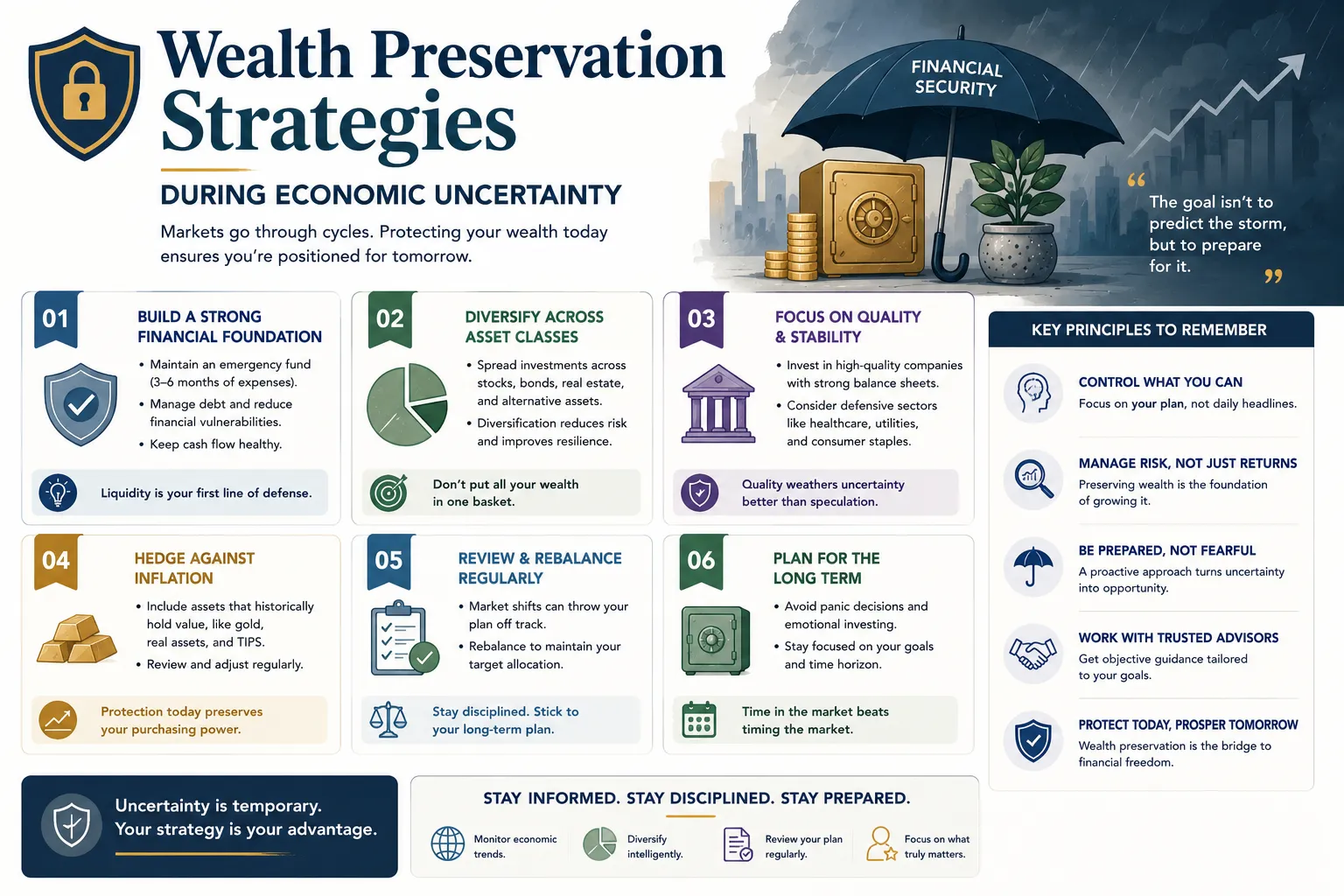
Wealth Preservation Strategies During Economic Uncertainty
Periods of economic uncertainty create significant challenges for investors, business owners, retirees, and high-net-worth individuals. Rising inflation, market volatility, geopolitical tensions, changing interest rates, banking sector instability, global recessions, and unpredictable policy decisions can quickly impact investment portfolios and long-term financial plans.
While many investors focus exclusively on wealth accumulation, experienced financial professionals understand that preserving wealth is equally important. Protecting assets during uncertain economic periods can prevent devastating losses while positioning investors to capitalize on future opportunities.
Wealth preservation is not about avoiding risk entirely. Instead, it involves implementing strategic financial planning techniques designed to reduce unnecessary exposure while maintaining growth potential. Successful wealth preservation strategies balance capital protection, inflation management, tax efficiency, income generation, and long-term financial security.
In this comprehensive guide, we explore the most effective wealth preservation strategies that individuals, families, business owners, and retirees can implement to protect their financial future during uncertain economic conditions.
Understanding Economic Uncertainty and Its Impact on Wealth
Economic uncertainty refers to periods when financial markets, businesses, and consumers face increased unpredictability. During such times, traditional investment assumptions may not perform as expected.
Common drivers of economic uncertainty include:
- High inflation rates
- Central bank interest rate changes
- Stock market corrections
- Banking sector instability
- Global recessions
- Government debt concerns
- Currency fluctuations
- Geopolitical conflicts
- Supply chain disruptions
- Technological disruption
When uncertainty increases, investors often experience heightened volatility, declining asset values, reduced liquidity, and increased emotional decision-making. Wealth preservation strategies help minimize these risks.
Why Wealth Preservation Matters More Than Ever
Building wealth often takes decades, but significant losses can occur within months during severe economic downturns. Recovering from major losses becomes increasingly difficult as investors approach retirement or depend on investment income.
Effective wealth preservation helps:
- Protect accumulated assets
- Maintain purchasing power
- Reduce portfolio volatility
- Generate reliable income
- Preserve retirement savings
- Support estate planning goals
- Enhance long-term financial security
- Reduce emotional investment decisions
Strategy #1: Diversification Across Asset Classes
Diversification remains one of the most powerful wealth preservation tools available. Concentrating wealth in a single investment, industry, or geographic region increases exposure to unexpected risks.
A diversified portfolio may include:
- Domestic equities
- International equities
- Government bonds
- Corporate bonds
- Real estate
- REITs
- Cash equivalents
- Precious metals
- Alternative investments
- Private market assets
Different asset classes often respond differently to economic events, helping reduce overall portfolio risk.
| Asset Class | Risk Level | Inflation Protection | Income Potential |
|---|---|---|---|
| Cash | Low | Low | Low |
| Government Bonds | Low | Low | Moderate |
| Dividend Stocks | Moderate | Moderate | High |
| Real Estate | Moderate | High | High |
| Gold | Moderate | High | Low |
| Private Equity | High | Moderate | Variable |
Strategy #2: Maintain Adequate Liquidity
Liquidity plays a critical role during uncertain times. Investors who lack sufficient liquid assets may be forced to sell investments at unfavorable prices during market downturns.
Financial professionals typically recommend maintaining:
- Emergency savings funds
- Short-term cash reserves
- Money market accounts
- High-yield savings accounts
- Short-duration fixed income investments
Having readily accessible capital creates flexibility and reduces financial stress during economic disruptions.
Strategy #3: Focus on Quality Investments
High-quality investments tend to perform better during challenging economic conditions.
Characteristics of quality investments include:
- Strong balance sheets
- Consistent cash flow
- Low debt levels
- Competitive advantages
- Reliable management teams
- Long operating histories
- Stable earnings growth
Companies with these characteristics often demonstrate greater resilience during recessions and market corrections.
Strategy #4: Inflation Protection Strategies
Inflation represents one of the greatest threats to long-term wealth preservation because it steadily reduces purchasing power.
Assets commonly used to hedge inflation include:
- Real estate investments
- Infrastructure assets
- Dividend growth stocks
- Treasury inflation-protected securities
- Commodities
- Energy investments
- Precious metals
Investors should regularly evaluate whether their portfolios can maintain purchasing power under prolonged inflationary conditions.
Strategy #5: Utilize Defensive Investment Sectors
Certain industries tend to remain relatively stable regardless of economic conditions.
Defensive sectors often include:
- Healthcare
- Utilities
- Consumer staples
- Insurance companies
- Telecommunications
- Essential services
These businesses provide products and services consumers need regardless of economic circumstances.
Strategy #6: Tax-Efficient Wealth Preservation
Taxes can significantly impact long-term investment returns. Strategic tax planning helps preserve more of an investor's wealth over time.
Important tax-efficient strategies may include:
- Tax-loss harvesting
- Retirement account optimization
- Municipal bond investing
- Asset location planning
- Long-term capital gains management
- Charitable giving strategies
Reducing unnecessary tax liabilities can meaningfully improve wealth retention.
Strategy #7: Real Estate as a Wealth Preservation Tool
Real estate has historically played an important role in preserving wealth across economic cycles.
Potential advantages include:
- Inflation protection
- Rental income generation
- Portfolio diversification
- Tax benefits
- Long-term appreciation
- Tangible asset ownership
Investors may consider residential properties, commercial real estate, industrial assets, multifamily properties, or REITs depending on their objectives.
Strategy #8: Precious Metals and Safe-Haven Assets
Gold and other precious metals are often viewed as safe-haven assets during periods of economic instability.
Reasons investors allocate capital to precious metals include:
- Currency devaluation protection
- Inflation hedging
- Portfolio diversification
- Historical store of value
- Global demand
While precious metals typically do not generate income, they can provide valuable diversification benefits.
Strategy #9: Debt Management and Liability Reduction
Preserving wealth involves more than managing investments. Controlling liabilities is equally important.
Investors should evaluate:
- High-interest consumer debt
- Variable-rate loans
- Business liabilities
- Credit exposure
- Refinancing opportunities
Reducing debt improves financial flexibility and decreases vulnerability during economic slowdowns.
Strategy #10: Estate Planning and Asset Protection
Comprehensive wealth preservation extends beyond investment management.
Estate planning strategies may include:
- Trust structures
- Wills and beneficiary planning
- Family limited partnerships
- Asset protection trusts
- Business succession planning
- Charitable foundations
Proper estate planning helps protect wealth across generations while minimizing legal complications and tax burdens.
Building a Resilient Wealth Preservation Portfolio
An effective wealth preservation portfolio should balance growth, income, liquidity, and risk management.
| Asset Category | Example Allocation | Primary Objective |
|---|---|---|
| Quality Equities | 40% | Growth & Income |
| Fixed Income | 25% | Stability |
| Real Estate | 15% | Inflation Protection |
| Alternative Assets | 10% | Diversification |
| Cash Reserves | 10% | Liquidity |
Behavioral Finance and Wealth Preservation
One of the greatest threats to wealth preservation is emotional investing. Fear, greed, panic, and overconfidence frequently lead investors to make poor decisions.
Common behavioral mistakes include:
- Panic selling during market declines
- Chasing speculative investments
- Ignoring diversification principles
- Overreacting to headlines
- Attempting to time the market
Maintaining a disciplined investment process helps reduce emotional decision-making and improves long-term outcomes.
Economic Uncertainty Opportunities
While uncertainty creates risks, it can also create opportunities. Investors with strong liquidity positions and disciplined strategies often benefit from market dislocations.
Potential opportunities may include:
- Discounted stock valuations
- Real estate acquisitions
- Private market investments
- Dividend reinvestment opportunities
- Sector rotation strategies
Successful wealth preservation does not mean avoiding opportunities—it means approaching them with careful risk management.
Modern Wealth Preservation Trends for 2026 and Beyond
Several emerging trends are influencing modern wealth management strategies:
- Artificial intelligence-driven investment analysis
- Private credit markets
- Infrastructure investing
- Cybersecurity-related investments
- Renewable energy assets
- Digital wealth management platforms
- Alternative income-producing assets
- Global diversification strategies
Investors who adapt to evolving market conditions while maintaining disciplined wealth preservation principles may be better positioned for long-term success.
Final Thoughts
Economic uncertainty is inevitable. Markets will continue experiencing cycles of expansion, contraction, volatility, and recovery. While no strategy can eliminate risk entirely, investors can significantly improve their financial resilience through thoughtful wealth preservation planning.
The most effective wealth preservation strategies combine diversification, liquidity management, inflation protection, tax efficiency, quality investments, estate planning, and disciplined decision-making. Together, these approaches help protect accumulated wealth while maintaining opportunities for future growth.
Whether you are a retiree protecting lifetime savings, a business owner managing financial risks, or a high-net-worth investor building a multi-generational legacy, implementing a comprehensive wealth preservation strategy can help safeguard your financial future during uncertain economic times and beyond.