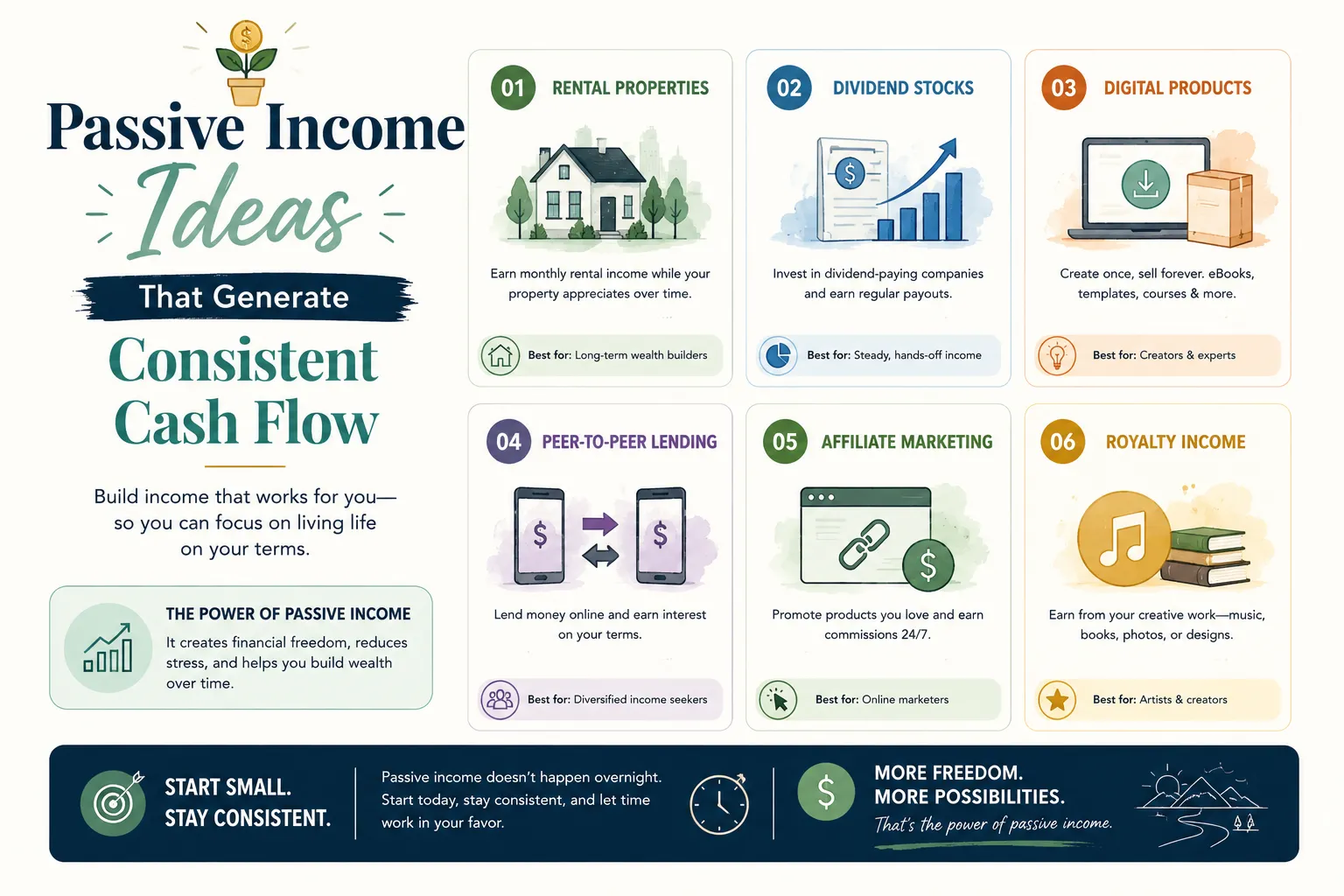
Passive Income Ideas That Generate Consistent Cash Flow
Passive income has become one of the most sought-after financial goals in the modern economy. Whether the objective is achieving financial freedom, supplementing employment income, preparing for retirement, or building generational wealth, passive income streams offer a pathway toward greater financial security and flexibility.
Unlike traditional active income, which requires continuous time and effort, passive income is designed to generate revenue with limited ongoing involvement. While most passive income strategies require an initial investment of money, time, expertise, or resources, the long-term benefit is the ability to create recurring cash flow that continues working even when you are not actively engaged.
In 2026, advancements in technology, digital business models, global investing platforms, and alternative investment opportunities have expanded the number of passive income options available to investors and entrepreneurs. From dividend-paying stocks and real estate investments to digital products, affiliate marketing, and automated online businesses, individuals have more opportunities than ever to build sustainable recurring income streams.
This comprehensive guide explores the most effective passive income ideas that generate consistent cash flow while supporting long-term wealth accumulation and financial independence.
What Is Passive Income?
Passive income refers to earnings generated from investments, assets, or businesses that require minimal daily involvement after the initial setup phase.
Common characteristics include:
- Recurring revenue generation.
- Scalability.
- Potential for long-term growth.
- Reduced dependence on active labor.
- Ability to diversify income sources.
While no passive income stream is entirely effortless, many can become highly automated and require significantly less work than traditional employment.
Why Passive Income Matters in 2026
Several economic trends are increasing the importance of passive income:
- Rising living costs.
- Inflation pressures.
- Longer retirement periods.
- Economic uncertainty.
- Rapid technological change.
- Growing demand for financial independence.
Building multiple income streams helps reduce reliance on a single employer or business and creates greater financial resilience.
1. Dividend Stocks
Dividend investing remains one of the most popular passive income strategies among long-term investors.
Dividend-paying companies distribute a portion of profits to shareholders through regular cash payments.
Benefits of Dividend Stocks
- Consistent income generation.
- Potential capital appreciation.
- Dividend growth over time.
- Tax advantages in some jurisdictions.
- Portfolio diversification.
| Investment Feature | Benefit |
|---|---|
| Quarterly Dividends | Recurring Cash Flow |
| Dividend Growth | Income Expansion |
| Stock Appreciation | Capital Growth |
| Reinvestment Options | Compounding Potential |
Dividend growth investing has helped many investors build substantial passive income portfolios over decades.
2. Dividend ETFs
Dividend ETFs offer instant diversification while generating passive income from multiple dividend-paying companies.
Advantages include:
- Lower company-specific risk.
- Broad diversification.
- Professional portfolio management.
- Regular distributions.
- Low investment minimums.
For beginners, dividend ETFs often provide a simpler alternative to selecting individual dividend stocks.
3. Rental Real Estate
Rental properties remain one of the most powerful cash-flow-producing assets available.
Potential benefits include:
- Monthly rental income.
- Property appreciation.
- Tax benefits.
- Inflation protection.
- Leverage opportunities.
Residential, commercial, industrial, and vacation rental properties can all generate recurring income while increasing long-term net worth.
4. Real Estate Investment Trusts (REITs)
Investors who prefer not to manage physical properties often use REITs to gain real estate exposure.
REITs own income-producing properties such as:
- Apartment complexes.
- Office buildings.
- Industrial warehouses.
- Healthcare facilities.
- Data centers.
- Retail properties.
REITs frequently distribute substantial portions of rental income to shareholders.
5. High-Yield Savings Accounts and Cash Management Accounts
Although generally offering lower returns than equities or real estate, high-yield savings accounts provide low-risk passive income.
Advantages include:
- Liquidity.
- Capital preservation.
- Low risk.
- Predictable interest earnings.
These accounts can serve as part of a diversified income strategy.
6. Bond Investments
Bonds provide fixed-income payments and are commonly used by retirees and conservative investors.
Popular categories include:
- Government bonds.
- Corporate bonds.
- Municipal bonds.
- Treasury securities.
Bond income can contribute to portfolio stability while generating recurring cash flow.
7. Digital Products
The digital economy has created numerous passive income opportunities.
Examples include:
- E-books.
- Online courses.
- Templates.
- Software tools.
- Digital downloads.
- Premium educational content.
Once developed, digital products can be sold repeatedly with minimal incremental cost.
8. Affiliate Marketing
Affiliate marketing allows creators to earn commissions by promoting products and services.
Popular affiliate niches include:
- Insurance.
- Investing platforms.
- Software subscriptions.
- Business services.
- Cybersecurity solutions.
- Cloud computing services.
Many of these niches offer exceptionally high advertising rates and affiliate commissions.
9. Online Content Businesses
Content-driven websites can generate passive income through:
- Display advertising.
- Affiliate marketing.
- Sponsored content.
- Lead generation.
- Digital product sales.
Finance, insurance, investing, legal services, SaaS, and business software content often generate some of the highest advertising revenue per visitor.
10. Subscription-Based Businesses
Recurring subscription models are highly attractive because they generate predictable monthly revenue.
Examples include:
- Membership communities.
- Premium newsletters.
- Software-as-a-Service (SaaS).
- Research subscriptions.
- Educational platforms.
Recurring revenue improves cash flow consistency and business valuation.
11. Investing in Private Credit
Private credit has emerged as a growing alternative investment category.
Benefits include:
- Regular interest income.
- Potentially higher yields.
- Diversification benefits.
- Alternative return sources.
Institutional and accredited investors increasingly allocate capital toward private lending opportunities.
12. Peer-to-Peer Lending
Peer-to-peer lending platforms connect borrowers with investors.
Investors may receive:
- Interest payments.
- Portfolio diversification.
- Alternative income streams.
Proper risk assessment remains essential when evaluating lending opportunities.
13. Licensing Intellectual Property
Creators can generate recurring income by licensing intellectual property.
Examples include:
- Photography.
- Music.
- Software.
- Patents.
- Design assets.
- Educational content.
Licensing allows creators to monetize assets repeatedly without reselling ownership.
14. Automated E-Commerce Businesses
Modern automation tools have made e-commerce more scalable than ever.
Income sources include:
- Print-on-demand products.
- Digital products.
- Private label brands.
- Subscription commerce.
Automation reduces operational demands while maintaining revenue generation.
15. Data Center and Infrastructure Investments
As AI adoption expands, digital infrastructure investments are attracting significant attention.
Popular sectors include:
- Data centers.
- Cell towers.
- Fiber networks.
- Cloud infrastructure.
Many infrastructure investments provide recurring income through long-term contracts.
16. Renewable Energy Investments
Renewable energy projects increasingly offer income-producing opportunities.
Examples include:
- Solar farms.
- Wind energy projects.
- Energy infrastructure funds.
- Renewable energy REITs.
Growing global energy demand may support long-term cash flow generation.
17. Franchise Ownership
Some franchise models can generate semi-passive income with professional management teams handling daily operations.
Advantages include:
- Established business systems.
- Brand recognition.
- Recurring customer demand.
- Potential scalability.
18. Creating an Investment Portfolio Designed for Income
Many investors combine multiple passive income assets within a single portfolio.
| Asset Class | Purpose |
|---|---|
| Dividend Stocks | Income + Growth |
| Dividend ETFs | Diversified Income |
| REITs | Real Estate Cash Flow |
| Bonds | Stability & Income |
| Alternative Assets | Diversification |
| Cash Reserves | Liquidity |
This diversified approach can improve both cash flow consistency and risk management.
Common Passive Income Mistakes
Many investors reduce results by making avoidable mistakes.
- Chasing unrealistic yields.
- Ignoring diversification.
- Failing to assess risk.
- Neglecting tax planning.
- Overconcentration in one income source.
- Underestimating maintenance requirements.
Successful passive income investing requires careful planning and realistic expectations.
How High Net Worth Individuals Build Passive Income
Many wealthy investors focus heavily on recurring income generation.
| Income Source | Typical Objective |
|---|---|
| Dividend Portfolios | Growing Cash Flow |
| Commercial Real Estate | Rental Income |
| Private Businesses | Recurring Revenue |
| Private Credit | Interest Income |
| Alternative Assets | Diversified Returns |
The most successful investors rarely rely on a single source of passive income.
The Role of Passive Income in Financial Freedom
Financial freedom occurs when passive income consistently covers living expenses.
Benefits include:
- Greater lifestyle flexibility.
- Reduced dependence on employment.
- Enhanced retirement security.
- Increased wealth accumulation.
- Improved financial resilience.
Building multiple passive income streams can significantly accelerate progress toward financial independence.
Conclusion
Passive income remains one of the most effective tools for building wealth, increasing financial security, and achieving long-term financial freedom. Whether through dividend stocks, REITs, rental properties, online businesses, digital products, infrastructure investments, or alternative income-producing assets, investors now have more opportunities than ever to create consistent recurring cash flow.
The most successful passive income strategies combine diversification, disciplined investing, risk management, and long-term thinking. Rather than relying on a single source of income, investors can create resilient portfolios that generate cash flow across multiple economic environments.
As technology, digital business models, and investment opportunities continue evolving throughout 2026 and beyond, passive income will remain a cornerstone of sustainable wealth creation and financial independence.