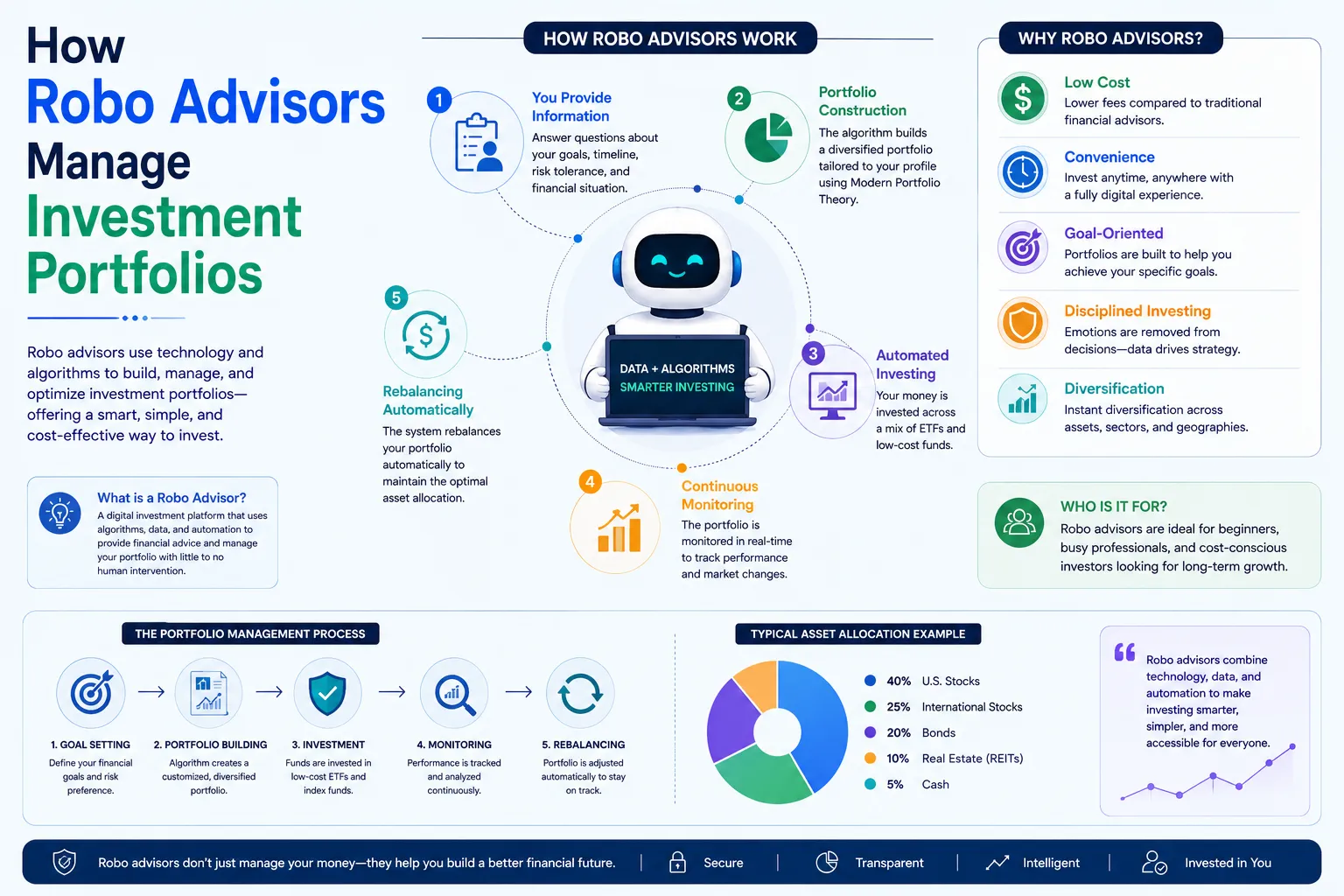
How Robo Advisors Manage Investment Portfolios
The investment management industry has undergone a major transformation over the past decade. Traditional wealth management services, once available primarily to high-net-worth individuals, are now accessible to everyday investors through robo advisors. These digital investment platforms use sophisticated algorithms, automation, artificial intelligence, and modern portfolio theory to create, monitor, and optimize investment portfolios at a fraction of the cost of traditional financial advisors.
As financial technology continues to evolve, robo advisors have become increasingly popular among investors seeking low-cost portfolio management, automated investing solutions, retirement planning assistance, and long-term wealth accumulation strategies. The growth of digital wealth management platforms has changed how millions of people approach investing.
Understanding how robo advisors manage investment portfolios helps investors make informed decisions about whether automated investing solutions align with their financial goals, risk tolerance, and investment objectives.
What Is a Robo Advisor?
A robo advisor is a digital investment management platform that uses algorithms and automated technology to build and manage investment portfolios with minimal human intervention.
Unlike traditional financial advisors who manually create investment strategies, robo advisors rely on data-driven systems to make investment decisions based on client preferences and financial objectives.
Most robo advisors provide:
- Portfolio construction
- Risk assessment
- Asset allocation
- Automatic rebalancing
- Tax optimization
- Retirement planning
- Goal-based investing
These features make investing more accessible and affordable for a broader range of investors.
How Robo Advisors Work
The robo advisor process begins when an investor completes a questionnaire designed to evaluate financial circumstances and investment preferences.
The platform gathers information about:
- Investment goals
- Risk tolerance
- Investment timeline
- Income level
- Financial obligations
- Retirement objectives
- Liquidity needs
Using this information, the robo advisor generates a customized portfolio designed to match the investor's profile.
| Investor Information | Portfolio Impact |
|---|---|
| Risk Tolerance | Asset Allocation |
| Investment Horizon | Growth Strategy |
| Financial Goals | Portfolio Design |
| Income Requirements | Income-Producing Assets |
| Liquidity Needs | Cash Allocation |
The Role of Modern Portfolio Theory
Many robo advisors rely heavily on Modern Portfolio Theory (MPT), a framework developed to maximize expected returns while minimizing risk through diversification.
The core principle of MPT is that investors should not evaluate individual investments in isolation. Instead, they should focus on how investments work together within a portfolio.
Robo advisors use this approach to create diversified portfolios that balance:
- Risk exposure
- Expected returns
- Market volatility
- Investment objectives
Portfolio Diversification Strategies
Diversification is one of the most important portfolio management techniques used by robo advisors.
Rather than concentrating investments in a single asset, robo advisors spread capital across multiple asset classes.
Common asset categories include:
- Domestic stocks
- International stocks
- Government bonds
- Corporate bonds
- Real estate investment trusts (REITs)
- Cash equivalents
- Alternative investments
This diversification helps reduce overall portfolio risk while maintaining growth potential.
Asset Allocation Explained
Asset allocation determines how investments are distributed among various asset classes.
It is often considered the most important factor influencing long-term investment performance.
Robo advisors typically use risk-based allocation models.
| Investor Profile | Stocks | Bonds | Cash |
|---|---|---|---|
| Conservative | 30% | 60% | 10% |
| Moderate | 60% | 35% | 5% |
| Aggressive | 85% | 10% | 5% |
The exact allocation varies depending on the platform and investor preferences.
Exchange-Traded Funds and Robo Advisors
Most robo advisors primarily invest through Exchange-Traded Funds (ETFs).
ETFs offer several advantages:
- Low expense ratios
- Broad diversification
- Liquidity
- Transparency
- Tax efficiency
Using ETFs allows robo advisors to build diversified portfolios while keeping costs relatively low.
Risk Assessment Technology
Risk profiling is a crucial component of automated portfolio management.
Robo advisors use sophisticated questionnaires and analytics to determine an investor's ability and willingness to tolerate risk.
Factors considered include:
- Age
- Investment experience
- Income stability
- Financial obligations
- Market volatility tolerance
- Long-term goals
This information guides portfolio construction and investment recommendations.
Automatic Portfolio Rebalancing
Over time, market movements can cause portfolio allocations to drift away from target levels.
Robo advisors continuously monitor portfolios and automatically rebalance holdings when necessary.
Benefits include:
- Maintaining target allocations
- Controlling risk levels
- Enforcing investment discipline
- Reducing emotional decision-making
Automated rebalancing helps ensure portfolios remain aligned with investor objectives.
Tax-Loss Harvesting Strategies
Many advanced robo advisors offer automated tax-loss harvesting.
This strategy involves selling investments at a loss to offset taxable gains.
Potential benefits include:
- Reduced tax liabilities
- Improved after-tax returns
- Portfolio optimization
- Long-term wealth accumulation
Tax-efficient investing has become one of the most attractive features of modern robo advisor platforms.
| Tax Optimization Feature | Benefit |
|---|---|
| Tax-Loss Harvesting | Reduced Capital Gains Taxes |
| Asset Location | Improved Tax Efficiency |
| ETF Usage | Lower Tax Exposure |
| Automated Monitoring | Continuous Optimization |
Goal-Based Investing
Modern robo advisors increasingly focus on goal-based investing rather than simply maximizing returns.
Common financial goals include:
- Retirement planning
- Home purchases
- College funding
- Emergency savings
- Wealth accumulation
- Income generation
The platform adjusts investment strategies according to each specific objective.
Artificial Intelligence in Robo Advising
Artificial intelligence is playing an increasingly important role in digital wealth management.
AI technologies help robo advisors:
- Analyze market data
- Identify investment opportunities
- Improve risk models
- Personalize recommendations
- Enhance customer experiences
As AI capabilities continue advancing, robo advisors are becoming increasingly sophisticated.
Behavioral Finance and Investor Psychology
One major advantage of robo advisors is their ability to remove emotional decision-making from investing.
Human investors often make mistakes such as:
- Panic selling
- Market timing
- Overtrading
- Performance chasing
- Loss aversion
Automated systems follow predefined rules and maintain investment discipline regardless of market conditions.
Retirement Planning Features
Retirement planning remains one of the most popular use cases for robo advisors.
Platforms often provide:
- Retirement calculators
- Contribution recommendations
- Goal tracking
- Withdrawal planning
- Income forecasting
These tools help investors stay on track toward long-term retirement objectives.
Low-Cost Investment Management
Cost efficiency is one of the primary reasons investors choose robo advisors.
Compared with traditional wealth managers, robo advisors typically offer:
- Lower management fees
- Reduced account minimums
- Lower transaction costs
- Automated administration
Lower fees can significantly improve long-term investment returns.
Limitations of Robo Advisors
Despite their advantages, robo advisors are not perfect solutions for every investor.
Potential limitations include:
- Limited human interaction
- Less customized advice
- Complex financial situations may require human expertise
- Algorithm limitations
- Market uncertainty
Investors with highly specialized financial needs may still benefit from professional financial advisors.
Future Trends in Robo Advisory Services
The future of robo advising is expected to include:
- Advanced AI integration
- Personalized financial planning
- Real-time portfolio optimization
- Alternative investment access
- Enhanced tax strategies
- Hybrid human-digital advisory models
These innovations will likely make automated investing even more effective and accessible.
Who Should Consider a Robo Advisor?
Robo advisors can be particularly beneficial for:
- Beginning investors
- Long-term investors
- Retirement savers
- Cost-conscious individuals
- Passive investors
- Busy professionals
They provide a simple and efficient way to build diversified portfolios without requiring extensive investment expertise.
Conclusion
Robo advisors have revolutionized investment management by combining technology, automation, portfolio theory, artificial intelligence, and cost-efficient investing strategies. Through diversified asset allocation, automated rebalancing, tax optimization, and goal-based planning, these platforms help investors build and manage portfolios with minimal effort.
As financial technology continues evolving, robo advisors are expected to become even more sophisticated, offering enhanced personalization, improved risk management, and more powerful wealth-building tools. For many investors, robo advisors represent an efficient, affordable, and accessible solution for achieving long-term financial goals in an increasingly digital financial landscape.