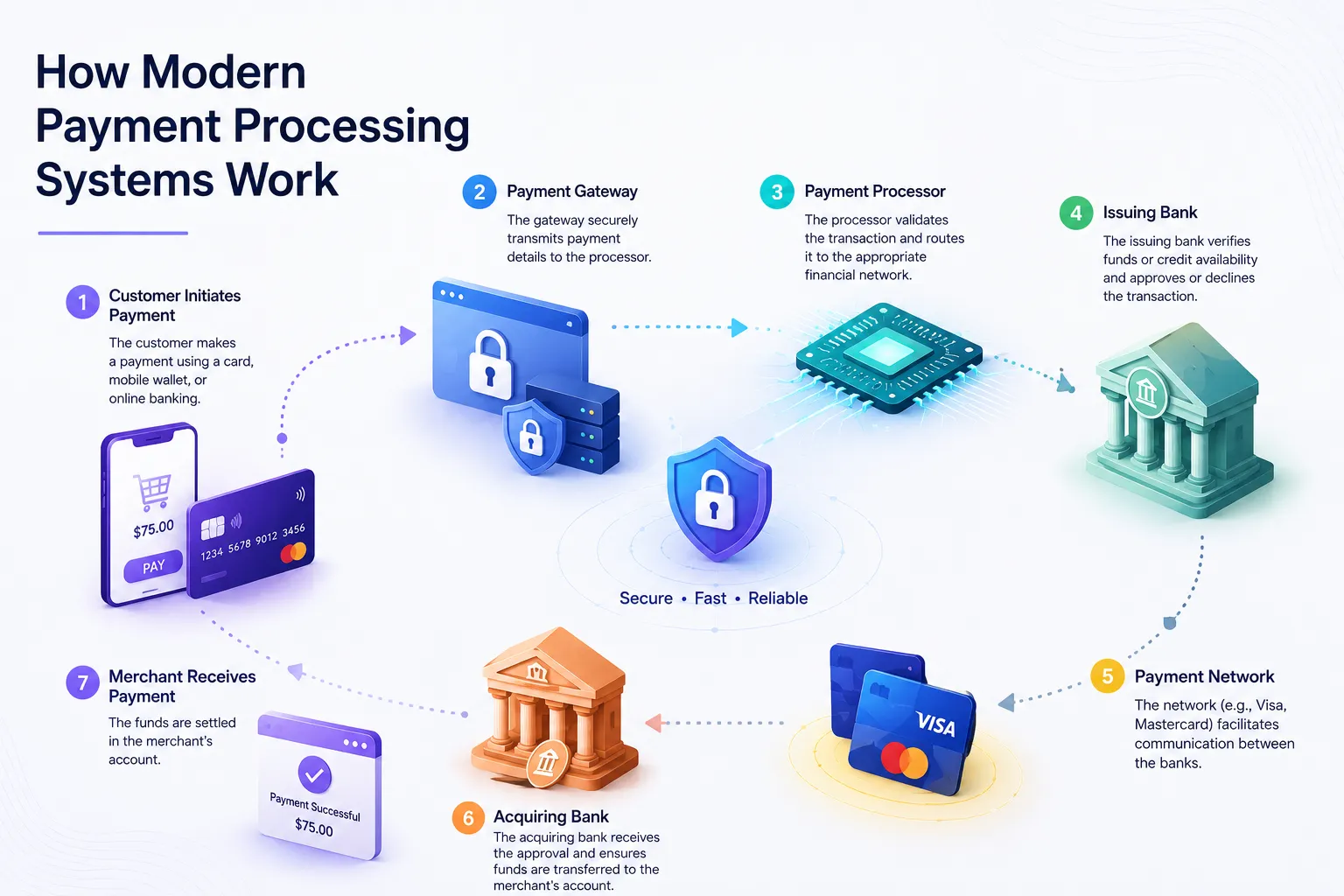
How Modern Payment Processing Systems Work
The global economy increasingly depends on fast, secure, and seamless digital payment systems. Whether a consumer purchases a product online, pays for a subscription service, taps a smartphone at a retail store, or sends money internationally, modern payment processing systems work behind the scenes to authorize, verify, and settle transactions within seconds.
Today’s payment ecosystem is far more sophisticated than traditional cash transactions. Financial institutions, payment gateways, merchant processors, card networks, cybersecurity platforms, fraud detection engines, cloud infrastructure providers, and fintech companies collaborate to ensure billions of transactions are completed safely and efficiently every day.
As ecommerce, digital banking, mobile commerce, subscription services, software-as-a-service (SaaS) businesses, and embedded finance continue growing globally, payment processing has become one of the highest-value sectors within financial technology. Businesses that understand payment systems can improve conversion rates, reduce fraud, lower transaction costs, and enhance customer experiences.
This comprehensive guide explains how modern payment processing systems work, the technologies involved, security requirements, payment methods, emerging trends, and the future of digital transactions.
What Is Payment Processing?
Payment processing refers to the technology and infrastructure that facilitate the transfer of funds between a customer and a merchant during a financial transaction.
The process includes:
- Payment authorization
- Transaction verification
- Fraud screening
- Funds transfer
- Settlement and reconciliation
- Reporting and analytics
Modern payment systems are designed to complete these functions quickly, securely, and accurately.
| Payment Component | Primary Function |
|---|---|
| Payment Gateway | Transmits Transaction Data |
| Payment Processor | Facilitates Authorization |
| Acquiring Bank | Supports Merchant Accounts |
| Issuing Bank | Provides Customer Payment Cards |
| Card Network | Routes Payment Information |
The Core Participants in Payment Processing
Several entities work together to complete a payment transaction.
Customer
The individual or business initiating a payment.
Merchant
The company receiving payment for products or services.
Payment Gateway
A payment gateway securely transfers payment information from the merchant to the payment processor.
Payment Processor
The processor manages communication between banks and card networks.
Acquiring Bank
The acquiring bank supports the merchant account receiving funds.
Issuing Bank
The issuing bank provides payment cards to consumers and approves transactions.
Card Networks
Card networks facilitate communication between financial institutions and processors.
Step-by-Step Payment Processing Workflow
A typical online payment transaction follows a structured sequence.
Step 1: Customer Initiates Payment
The customer enters payment information using a website, mobile app, point-of-sale system, or digital wallet.
Step 2: Payment Gateway Encrypts Data
Sensitive payment information is encrypted before transmission.
Step 3: Authorization Request
The payment processor sends the authorization request to the issuing bank.
Step 4: Risk Evaluation
Fraud detection systems analyze the transaction.
Step 5: Approval or Decline
The issuing bank approves or declines the transaction.
Step 6: Settlement
Approved funds move through settlement networks to the merchant account.
| Processing Stage | Purpose |
|---|---|
| Authorization | Verify Funds Availability |
| Authentication | Confirm Customer Identity |
| Fraud Screening | Assess Risk |
| Settlement | Transfer Funds |
| Reconciliation | Match Transaction Records |
Understanding Payment Gateways
A payment gateway serves as the digital equivalent of a physical payment terminal.
Its responsibilities include:
- Encrypting sensitive data
- Transmitting transaction requests
- Supporting multiple payment methods
- Managing authentication protocols
- Integrating with ecommerce platforms
Modern gateways support web, mobile, in-store, subscription, and embedded payment environments.
Merchant Accounts Explained
A merchant account is a specialized business bank account used to receive payment card transactions.
Funds are temporarily held before being deposited into the merchant’s operating account.
Merchant accounts often include:
- Transaction reporting
- Chargeback management
- Settlement tracking
- Fraud monitoring tools
Credit Card Payment Processing
Credit card transactions remain one of the most common payment methods worldwide.
Key advantages include:
- Consumer convenience
- Global acceptance
- Fraud protection
- Rewards programs
- Consumer dispute mechanisms
Card processing relies heavily on secure network infrastructure and real-time authorization systems.
Debit Card Transactions
Debit card payments function similarly to credit card transactions but directly access available funds in the customer’s bank account.
Benefits include:
- Lower debt risk
- Immediate account deduction
- Broad merchant acceptance
- Lower processing costs in some regions
Digital Wallet Technology
Digital wallets have become increasingly popular in both developed and emerging markets.
Examples of digital wallet capabilities include:
- Contactless payments
- Peer-to-peer transfers
- Loyalty integration
- Tokenized payment credentials
- Mobile commerce support
Digital wallets improve convenience while enhancing security through tokenization technologies.
| Payment Method | Key Benefit |
|---|---|
| Credit Card | Wide Acceptance |
| Debit Card | Direct Account Access |
| Digital Wallet | Convenience and Security |
| ACH Transfer | Lower Processing Costs |
| Real-Time Payments | Instant Settlement |
Payment Security and Fraud Prevention
Security is one of the most important aspects of payment processing.
Financial losses from fraud can be substantial for both merchants and consumers.
Encryption
Encryption protects sensitive payment information during transmission.
Tokenization
Tokenization replaces sensitive card data with unique digital tokens.
Machine Learning Fraud Detection
AI-powered systems analyze billions of transactions to identify suspicious activity.
Behavioral Analytics
Behavior-based monitoring helps detect unauthorized account access.
PCI DSS Compliance
Payment Card Industry Data Security Standards (PCI DSS) establish security requirements for organizations handling payment data.
Compliance objectives include:
- Protecting cardholder information
- Reducing fraud risk
- Improving cybersecurity
- Maintaining consumer trust
Businesses processing payment cards must comply with applicable PCI requirements.
Real-Time Payment Networks
Real-time payments are transforming global financial infrastructure.
Benefits include:
- Immediate transfers
- Improved cash flow
- Enhanced customer satisfaction
- Faster business operations
Many countries are investing heavily in instant payment systems to support economic growth.
Cross-Border Payment Processing
Global commerce depends on efficient international payment systems.
Cross-border transactions introduce additional complexities:
- Currency conversion
- Regulatory compliance
- Settlement delays
- Fraud monitoring
- International banking networks
Fintech innovation continues improving the speed and efficiency of global payments.
Subscription Billing Systems
Recurring payment models have become increasingly common.
Industries using subscription billing include:
- Software-as-a-Service
- Streaming platforms
- Membership businesses
- Cloud computing services
- Digital media providers
Modern payment processors provide automated recurring billing infrastructure.
Embedded Payments and Commerce
Embedded payments integrate financial transactions directly into digital platforms.
Examples include:
- Ride-sharing apps
- Marketplace platforms
- Food delivery services
- Business software systems
- Healthcare payment solutions
This trend simplifies user experiences while creating new revenue opportunities.
Artificial Intelligence in Payment Processing
Artificial intelligence is becoming increasingly important throughout the payment lifecycle.
AI applications include:
- Fraud prevention
- Risk scoring
- Customer service automation
- Transaction monitoring
- Payment optimization
Machine learning systems continuously improve as they process additional transaction data.
| AI Application | Business Benefit |
|---|---|
| Fraud Detection | Reduced Financial Losses |
| Risk Assessment | Better Decision Making |
| Automation | Operational Efficiency |
| Customer Support | Improved Service Quality |
Cloud Computing and Payment Infrastructure
Cloud technology supports the scalability and reliability of modern payment systems.
Advantages include:
- Global availability
- High uptime
- Rapid deployment
- Cost efficiency
- Enhanced disaster recovery
Cloud-based architectures help payment providers handle transaction spikes during peak demand periods.
Challenges Facing Payment Processors
Despite technological advances, payment providers face ongoing challenges.
| Challenge | Potential Impact |
|---|---|
| Fraud | Financial Losses |
| Cybersecurity Threats | Data Breaches |
| Regulatory Changes | Compliance Costs |
| Chargebacks | Revenue Loss |
| Cross-Border Complexity | Operational Challenges |
Future Trends in Payment Processing
The future of payment processing is being shaped by several emerging technologies.
- Artificial intelligence
- Open banking APIs
- Blockchain infrastructure
- Embedded finance
- Digital identity verification
- Biometric authentication
- Central bank digital currencies
These innovations aim to improve efficiency, security, accessibility, and customer experiences.
How Businesses Can Optimize Payment Processing
Organizations seeking to maximize payment performance should focus on:
- Selecting reliable processors
- Reducing checkout friction
- Supporting multiple payment methods
- Enhancing fraud prevention
- Maintaining compliance standards
- Monitoring transaction analytics
Optimization efforts often improve conversion rates, reduce abandonment, and increase customer satisfaction.
Final Thoughts
Modern payment processing systems are among the most critical components of the global financial ecosystem. Every online purchase, subscription payment, mobile wallet transaction, and international transfer depends on sophisticated networks working together to authorize, verify, secure, and settle transactions in real time.
Advances in artificial intelligence, cloud computing, cybersecurity, open banking, embedded finance, and digital identity technologies continue transforming the payments industry. Businesses that understand these systems can improve operational efficiency, reduce risk, enhance customer experiences, and support long-term growth.
As digital commerce expands and consumer expectations continue evolving, payment processing will remain a key driver of financial innovation. Organizations that invest in secure, scalable, and customer-focused payment infrastructure will be best positioned to succeed in the increasingly digital economy.