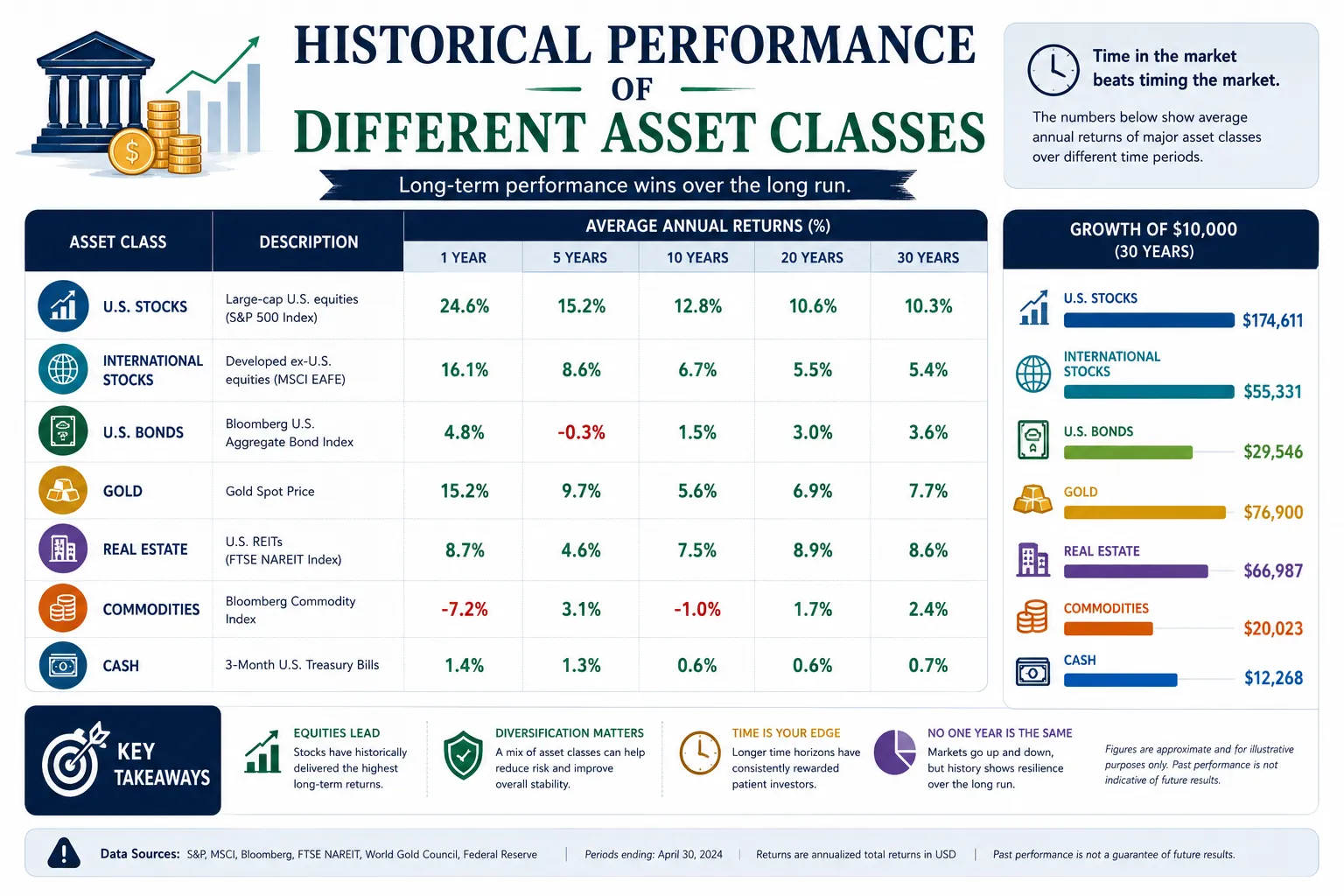
Historical Performance of Different Asset Classes
One of the most important lessons investors learn over time is that no single asset class consistently outperforms every other investment category. Markets move through cycles, economies evolve, interest rates change, and investor sentiment fluctuates. Understanding the historical performance of different asset classes helps investors build diversified portfolios designed to withstand uncertainty while pursuing long-term wealth creation.
Whether you're planning for retirement, building passive income streams, preserving wealth, or seeking portfolio growth, analyzing historical asset class performance provides valuable insights into risk, return, volatility, and diversification benefits.
While historical returns do not guarantee future results, they remain one of the most effective tools for understanding how investments behave across economic environments. Investors who understand asset class behavior often make more informed portfolio allocation decisions and avoid costly emotional reactions during market volatility.
This comprehensive guide examines the long-term historical performance of major asset classes, including stocks, bonds, real estate, commodities, gold, REITs, private equity, cash investments, and alternative assets.
What Is an Asset Class?
An asset class is a group of investments that share similar characteristics, risk profiles, return expectations, and market behaviors.
Major asset classes include:
- Stocks (Equities)
- Bonds (Fixed Income)
- Cash and Cash Equivalents
- Real Estate
- REITs (Real Estate Investment Trusts)
- Commodities
- Precious Metals
- Private Equity
- Infrastructure Investments
- Alternative Investments
Each asset class responds differently to economic growth, inflation, interest rates, and market cycles.
Why Historical Performance Matters
Historical performance analysis helps investors:
- Understand long-term return expectations
- Evaluate risk-adjusted returns
- Measure volatility
- Improve portfolio diversification
- Reduce emotional investing decisions
- Plan for retirement and wealth preservation
- Align investments with financial goals
Although future market conditions may differ from the past, long-term trends reveal valuable patterns that can guide portfolio construction.
Historical Asset Class Performance Overview
| Asset Class | Historical Annual Return Range | Risk Level | Inflation Protection |
|---|---|---|---|
| Large-Cap Stocks | 8% - 11% | Moderate-High | Strong |
| Small-Cap Stocks | 10% - 13% | High | Strong |
| International Stocks | 7% - 10% | Moderate-High | Moderate |
| Government Bonds | 3% - 6% | Low | Weak |
| Corporate Bonds | 4% - 7% | Moderate | Weak |
| Real Estate | 8% - 12% | Moderate | Strong |
| REITs | 8% - 11% | Moderate | Strong |
| Gold | 5% - 8% | Moderate | Excellent |
| Commodities | 4% - 8% | High | Excellent |
| Cash Equivalents | 1% - 4% | Very Low | Poor |
| Private Equity | 10% - 15% | High | Moderate |
Stocks: The Long-Term Wealth Builder
Historically, equities have delivered some of the strongest long-term returns among traditional asset classes. Stocks represent ownership in businesses, allowing investors to participate in corporate growth, profits, and innovation.
Advantages of Stocks
- Strong capital appreciation potential
- Dividend income opportunities
- Inflation protection
- Liquidity
- Long-term compounding benefits
Over multiple decades, broad stock market indexes have consistently generated higher returns than bonds and cash investments.
Large-Cap Stocks
Large-cap companies generally provide stable earnings, strong balance sheets, and diversified revenue streams. They often perform well during economic expansions while offering resilience during downturns.
Small-Cap Stocks
Small-cap companies historically generate higher average returns than large-cap stocks but experience greater volatility and business risk.
Bond Performance Throughout History
Bonds serve as the foundation of many conservative and balanced portfolios. Fixed-income investments provide predictable income streams and lower volatility than stocks.
Historically, bonds have:
- Reduced portfolio volatility
- Provided income stability
- Preserved capital during recessions
- Delivered lower but more consistent returns
Government bonds are generally considered among the safest investments, while corporate bonds offer higher yields in exchange for additional credit risk.
| Bond Type | Typical Historical Return | Risk Level |
|---|---|---|
| Treasury Bonds | 3% - 5% | Low |
| Municipal Bonds | 3% - 6% | Low |
| Investment Grade Corporate Bonds | 4% - 7% | Moderate |
| High Yield Bonds | 6% - 9% | High |
Real Estate: A Proven Wealth Preservation Asset
Real estate has historically delivered attractive risk-adjusted returns while providing inflation protection and income generation.
Real estate returns come from:
- Property appreciation
- Rental income
- Tax advantages
- Leverage opportunities
Commercial properties, multifamily housing, industrial real estate, and residential investments have all played important roles in wealth-building strategies across generations.
Many high-net-worth individuals allocate substantial portions of their portfolios to real estate because of its diversification benefits.
REITs: Real Estate with Liquidity
Real Estate Investment Trusts (REITs) provide exposure to real estate markets without requiring direct property ownership.
Historically, REITs have offered:
- Competitive total returns
- Attractive dividend yields
- Portfolio diversification
- Liquidity through public markets
REITs often perform differently from traditional stocks and bonds, making them useful diversification tools.
Gold Performance Across Economic Cycles
Gold has served as a store of value for centuries and remains one of the most recognized safe-haven assets.
Historically, gold performs particularly well during:
- High inflation periods
- Currency devaluation
- Geopolitical uncertainty
- Financial crises
While gold typically underperforms stocks during strong economic expansions, it often provides valuable protection during periods of market stress.
Commodities and Inflation Protection
Commodity investments include exposure to:
- Energy markets
- Agricultural products
- Industrial metals
- Natural resources
Historically, commodities have performed well during inflationary environments because rising prices directly impact commodity values.
However, commodities can be highly volatile and are generally best used as supplemental portfolio diversifiers rather than core holdings.
Cash and Money Market Investments
Cash remains the safest traditional asset class from a volatility perspective.
Benefits of cash include:
- Liquidity
- Capital preservation
- Emergency fund support
- Flexibility during market downturns
The primary disadvantage is inflation risk. Over long periods, cash investments typically fail to keep pace with inflation and wealth creation goals.
Private Equity Historical Performance
Private equity involves investing in companies that are not publicly traded.
Historically, private equity has generated strong returns because investors can:
- Participate in business growth
- Improve operational efficiency
- Benefit from acquisitions and exits
- Access opportunities unavailable in public markets
Private equity often delivers higher returns than public equities but comes with increased liquidity constraints and investment complexity.
Infrastructure Investments
Infrastructure assets include:
- Transportation systems
- Energy networks
- Telecommunications infrastructure
- Utilities
- Data centers
Historically, infrastructure investments have provided stable cash flows and inflation-linked revenue streams.
As global economies continue investing in modernization and digital transformation, infrastructure remains increasingly important.
Performance During Major Economic Events
Inflationary Periods
Historically strong performers:
- Real estate
- Gold
- Commodities
- Infrastructure
Economic Recessions
Historically resilient assets:
- Government bonds
- Cash
- Defensive dividend stocks
- Gold
Economic Expansions
Strongest performers often include:
- Stocks
- Small-cap equities
- Private equity
- Growth-oriented sectors
The Importance of Diversification
The historical record consistently demonstrates that diversification improves risk-adjusted returns.
Rather than attempting to predict which asset class will outperform next year, successful investors often maintain diversified portfolios designed to perform across various market environments.
| Portfolio Type | Growth Potential | Risk Level |
|---|---|---|
| Conservative | Moderate | Low |
| Balanced | High | Moderate |
| Growth | Very High | High |
| Aggressive Growth | Maximum | Very High |
Lessons Investors Can Learn from Historical Performance
- No asset class outperforms every year.
- Diversification reduces risk.
- Long-term investing generally rewards patience.
- Inflation must be considered when evaluating returns.
- Market volatility is normal.
- Asset allocation often influences results more than individual investment selection.
- Compounding remains one of the most powerful wealth-building forces.
Emerging Asset Classes in Modern Portfolios
Today's investors increasingly consider newer asset categories alongside traditional investments.
Examples include:
- Private credit funds
- Digital infrastructure
- Renewable energy projects
- Artificial intelligence-focused investments
- Data center real estate
- Venture capital funds
While these assets may offer attractive growth opportunities, they should be evaluated carefully within broader portfolio objectives.
Building an Asset Allocation Strategy for 2026 and Beyond
Modern portfolio construction increasingly focuses on balancing growth, income, inflation protection, and risk management.
Key considerations include:
- Investment objectives
- Risk tolerance
- Time horizon
- Income requirements
- Tax considerations
- Economic outlook
A thoughtful asset allocation strategy often proves more important than attempting to predict short-term market movements.
Final Thoughts
The historical performance of different asset classes provides valuable insights into how investments behave across economic cycles, market environments, and inflationary periods. Stocks have historically generated the strongest long-term returns, while bonds provide stability, real estate offers income and inflation protection, and alternative assets contribute diversification benefits.
No single investment can achieve every objective. Successful investors understand the strengths and limitations of each asset class and use diversification to create resilient portfolios capable of weathering uncertainty while pursuing long-term financial goals.
By studying historical asset class performance, investors can make more informed decisions, improve risk management, and build portfolios designed to preserve and grow wealth across generations.