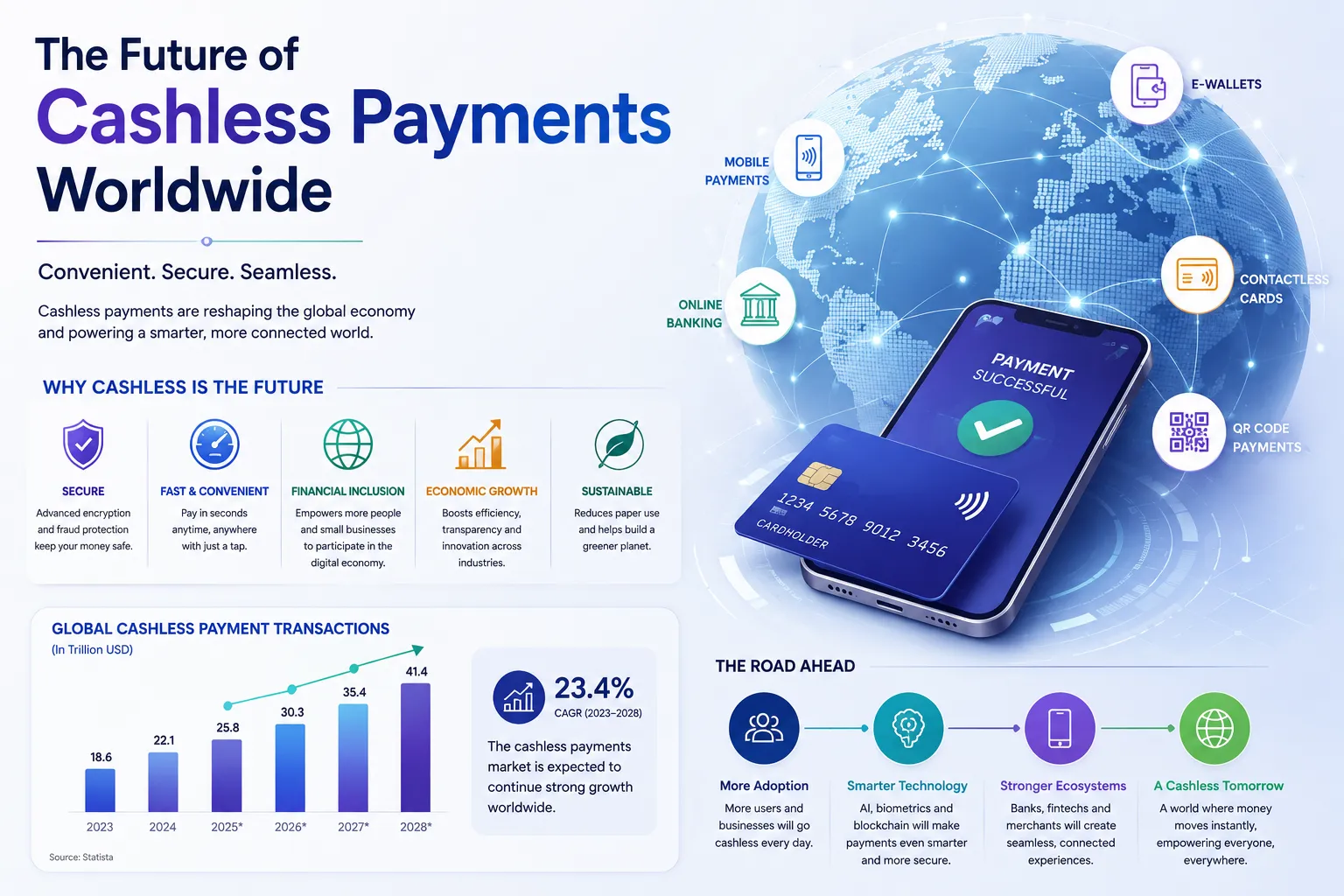
Future of Cashless Payments Worldwide
The global payments landscape is undergoing one of the most significant transformations in financial history. Cash, once the dominant medium of exchange, is steadily being replaced by digital payment technologies that offer greater speed, convenience, security, and efficiency. From mobile wallets and contactless cards to real-time payment networks and embedded finance platforms, cashless payments are reshaping how consumers, businesses, governments, and financial institutions interact with money.
The transition toward a cashless economy is driven by technological innovation, widespread smartphone adoption, growing internet penetration, e-commerce expansion, and increasing consumer demand for frictionless payment experiences. Financial institutions, fintech companies, payment processors, retailers, and technology providers are investing billions of dollars to build the next generation of digital payment infrastructure.
As we move further into the digital economy, understanding the future of cashless payments has become increasingly important for consumers, merchants, investors, financial institutions, and policymakers. This article explores the technologies, trends, opportunities, and challenges shaping the future of cashless transactions worldwide.
The Evolution of Payment Systems
Payment systems have evolved dramatically over the past several decades. Transactions that once required physical currency have increasingly shifted toward electronic alternatives.
The evolution typically followed this path:
- Cash-based transactions
- Paper checks
- Debit cards
- Credit cards
- Online banking payments
- Mobile wallets
- Real-time digital payments
- Embedded finance solutions
Each stage has improved transaction efficiency while reducing reliance on physical cash.
| Payment Method | Speed | Convenience | Global Adoption |
|---|---|---|---|
| Cash | Instant | Moderate | High |
| Checks | Slow | Low | Declining |
| Cards | Fast | High | Very High |
| Mobile Wallets | Instant | Very High | Rapid Growth |
| Real-Time Payments | Instant | Very High | Expanding |
Why the World Is Moving Toward Cashless Payments
Several factors are accelerating the adoption of cashless payment systems worldwide.
- Growth of e-commerce
- Smartphone penetration
- Digital banking adoption
- Contactless payment technologies
- Improved cybersecurity
- Consumer convenience expectations
- Government digitization initiatives
Digital payment ecosystems create faster and more efficient economic activity while supporting financial inclusion and innovation.
Digital Wallets Leading the Transformation
Digital wallets have become one of the most important drivers of cashless payment adoption.
Modern digital wallets allow users to:
- Store payment cards
- Make contactless purchases
- Transfer funds instantly
- Manage subscriptions
- Receive rewards
- Track spending activity
As smartphone usage continues expanding globally, digital wallets are expected to become a primary payment method across many markets.
Contactless Payment Technology
Contactless payment systems have experienced tremendous growth due to their convenience and speed.
Consumers can complete transactions using:
- Tap-to-pay credit cards
- Mobile phones
- Wearable devices
- Smart watches
- Digital wallets
Contactless technology reduces checkout times and improves customer experiences across retail environments.
Real-Time Payment Networks
Real-time payment systems are transforming how money moves between individuals and businesses.
Unlike traditional payment methods that may require hours or days for settlement, real-time payments offer:
- Instant transfers
- 24/7 availability
- Immediate settlement
- Enhanced liquidity management
- Improved customer satisfaction
Governments and financial institutions are increasingly investing in real-time payment infrastructure to modernize national financial systems.
| Payment Characteristic | Traditional Transfers | Real-Time Payments |
|---|---|---|
| Settlement Speed | Hours or Days | Seconds |
| Availability | Business Hours | 24/7 |
| Liquidity Access | Delayed | Immediate |
| User Experience | Moderate | Excellent |
Embedded Finance and Invisible Payments
Embedded finance is one of the fastest-growing areas within financial technology.
Embedded payments integrate financial services directly into non-financial platforms, allowing users to make transactions without leaving an application.
Examples include:
- E-commerce checkout financing
- Ride-sharing payments
- Subscription billing systems
- Marketplace payment solutions
- Integrated business software payments
The future of payments is increasingly becoming invisible and seamlessly integrated into everyday digital experiences.
Artificial Intelligence in Payment Processing
Artificial intelligence is playing a growing role in payment systems.
AI-powered solutions help financial institutions:
- Detect fraud
- Monitor transactions
- Assess risk
- Improve customer experiences
- Automate payment operations
Machine learning algorithms continuously analyze payment data to identify suspicious activities and improve security.
Payment Security Innovations
Security remains a critical priority in the cashless economy.
Modern payment systems utilize:
- Tokenization
- End-to-end encryption
- Biometric authentication
- Multi-factor authentication
- Behavioral analytics
- AI fraud detection
These technologies help protect consumers and businesses from cyber threats while maintaining trust in digital payment systems.
| Security Technology | Primary Function |
|---|---|
| Tokenization | Data Protection |
| Encryption | Secure Transmission |
| Biometrics | Identity Verification |
| AI Monitoring | Fraud Detection |
| MFA | Account Security |
Cross-Border Digital Payments
International payments remain a major area of innovation.
Traditional cross-border transfers often involve:
- High fees
- Multiple intermediaries
- Delayed settlements
- Complex compliance requirements
Modern payment technologies aim to simplify international transactions through faster processing, lower costs, and improved transparency.
Blockchain and Payment Innovation
Blockchain technology continues influencing the future of digital payments.
Potential benefits include:
- Faster settlements
- Reduced transaction costs
- Enhanced transparency
- Cross-border efficiency
- Improved security
Financial institutions continue exploring blockchain applications within payment processing ecosystems.
Role of Digital Banking in Cashless Economies
Digital banks play a vital role in supporting cashless payment adoption.
They provide:
- Digital account access
- Instant transfers
- Integrated payment solutions
- Mobile-first experiences
- Financial management tools
As digital banking grows, cashless transactions become more accessible to consumers worldwide.
Benefits for Businesses
Cashless payment systems offer numerous advantages for businesses.
- Faster transaction processing
- Reduced cash handling costs
- Improved accounting accuracy
- Enhanced customer experiences
- Better financial visibility
- Global payment acceptance
Businesses increasingly view digital payments as essential infrastructure rather than optional services.
Financial Inclusion Through Digital Payments
Cashless payment technologies can significantly improve financial inclusion.
Digital payment systems help underserved populations gain access to:
- Banking services
- Digital commerce
- Savings products
- Credit opportunities
- Government benefits
Mobile payment solutions are particularly important in emerging markets where traditional banking infrastructure may be limited.
Challenges Facing Cashless Adoption
Despite rapid growth, several challenges remain.
- Cybersecurity threats
- Privacy concerns
- Digital literacy gaps
- Infrastructure limitations
- Regulatory complexity
- Technology accessibility
Addressing these challenges will be critical to achieving sustainable global adoption.
Future Trends Shaping Cashless Payments
Several emerging trends are expected to define the next generation of payment systems.
- AI-powered payment automation
- Embedded financial services
- Biometric payment authentication
- Open banking ecosystems
- Programmable payments
- Digital identity platforms
- Cloud-native payment infrastructure
- Hyper-personalized financial experiences
These innovations will continue making payments faster, safer, and more integrated into everyday life.
The Long-Term Outlook for Cashless Economies
While cash is unlikely to disappear entirely in the near future, its role in everyday commerce is expected to decline steadily. Digital payment technologies continue offering compelling advantages in terms of convenience, efficiency, transparency, and scalability.
Financial institutions, governments, merchants, and consumers are increasingly embracing digital-first payment ecosystems. As infrastructure improves and technology advances, cashless transactions are expected to become the preferred payment method across most developed and emerging markets.
Conclusion
The future of cashless payments worldwide is being shaped by rapid technological innovation, evolving consumer preferences, and expanding digital financial ecosystems. From mobile wallets and contactless payments to real-time transfers, artificial intelligence, and embedded finance, the payment industry is entering a new era of transformation.
Organizations that embrace modern payment technologies will be better positioned to improve customer experiences, increase operational efficiency, enhance security, and participate in the growing digital economy. As the world moves closer to a cashless future, digital payments will continue serving as a foundational pillar of global commerce, financial inclusion, and economic growth.