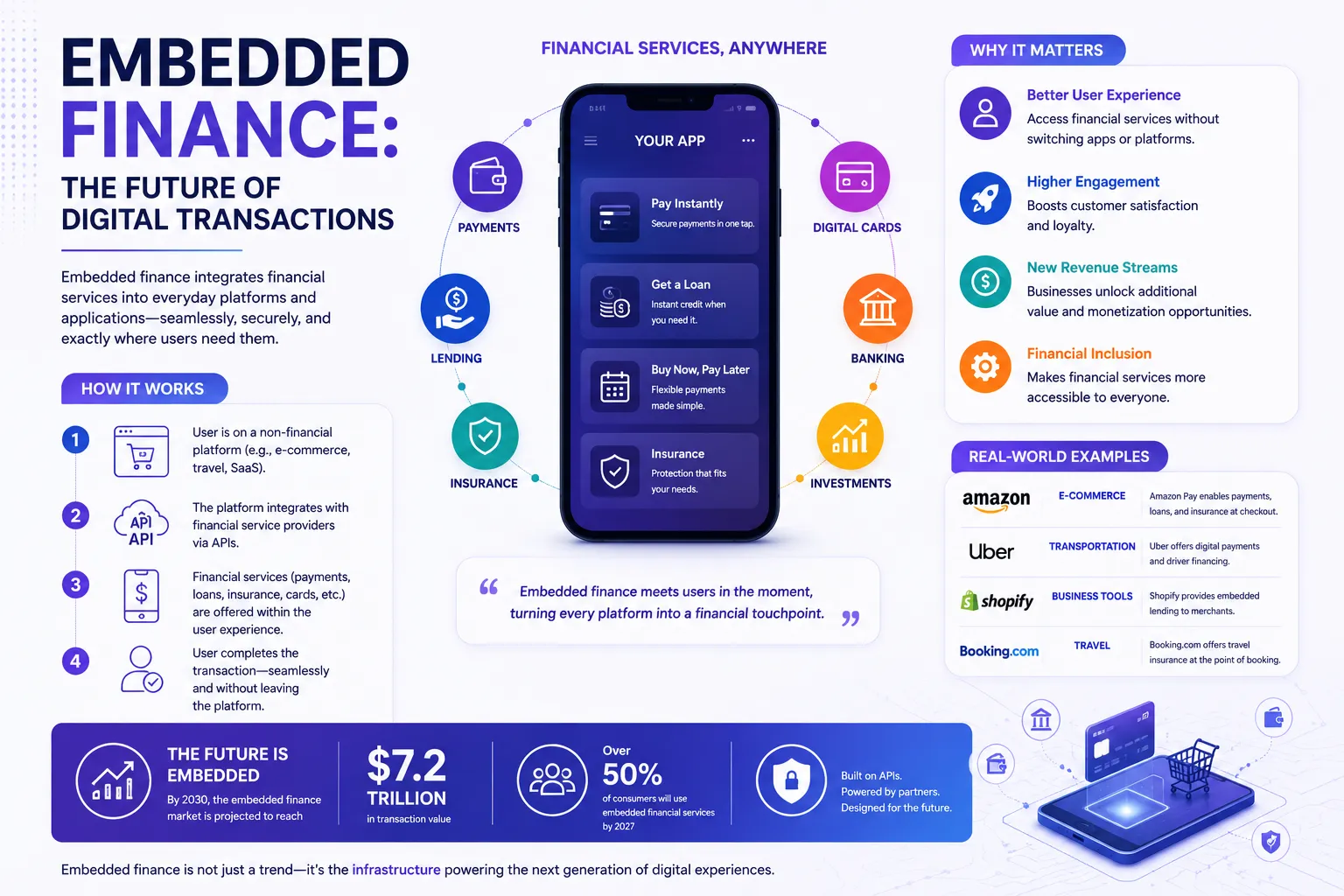
Embedded Finance: The Future of Digital Transactions
Financial services are no longer limited to traditional banks and financial institutions. Today, consumers can apply for credit while shopping online, purchase insurance during checkout, access business loans through accounting software, and make instant payments directly within mobile applications. This shift is being driven by embedded finance, one of the most transformative developments in the global financial services industry.
Embedded finance refers to the integration of financial products and services directly into non-financial platforms, applications, websites, marketplaces, and digital ecosystems. Instead of redirecting users to a separate financial institution, embedded finance enables seamless access to banking, lending, insurance, investments, and payment solutions exactly where they are needed.
As digital commerce continues expanding across Tier 1 economies such as the United States, Canada, the United Kingdom, Australia, Germany, and Singapore, embedded finance is creating entirely new revenue models and customer experiences. Financial technology companies, banks, SaaS providers, ecommerce businesses, and enterprise platforms are rapidly adopting embedded financial solutions to improve customer engagement and unlock new growth opportunities.
What Is Embedded Finance?
Embedded finance is the integration of financial services into non-financial digital experiences. These services are powered by APIs, Banking-as-a-Service (BaaS) platforms, payment processors, fintech infrastructure providers, and open banking technologies.
Rather than requiring users to leave an application or website to access financial products, embedded finance allows transactions to occur within the user journey.
Examples include:
- Buy Now Pay Later (BNPL) at checkout
- Embedded business lending within accounting software
- Digital wallets inside ecommerce apps
- Embedded insurance during product purchases
- Integrated merchant payment processing
- In-app banking services
- Automated payroll solutions
| Traditional Finance | Embedded Finance |
|---|---|
| Separate Banking Experience | Integrated User Experience |
| Multiple Applications | Single Platform Access |
| Manual Processes | Automated Workflows |
| Long Approval Times | Real-Time Decisions |
| Higher Customer Friction | Seamless Transactions |
Why Embedded Finance Is Growing Rapidly
Several technological and market factors are accelerating embedded finance adoption worldwide.
- Growth of digital commerce
- Consumer demand for convenience
- Advances in API technology
- Open banking regulations
- Expansion of fintech ecosystems
- Demand for personalized financial experiences
- Mobile-first consumer behavior
Businesses increasingly recognize that integrating financial services directly into customer journeys improves conversion rates, customer retention, and revenue generation.
The Technology Behind Embedded Finance
Modern embedded finance relies on sophisticated technology infrastructure.
Key components include:
- Banking-as-a-Service (BaaS)
- Open Banking APIs
- Payment gateways
- Cloud computing platforms
- Identity verification systems
- Fraud prevention technologies
- Artificial intelligence solutions
These technologies allow businesses to launch financial products without building a bank from scratch.
Embedded Payments: The Foundation of Embedded Finance
Payments represent the most widely adopted embedded finance use case.
Embedded payments allow customers to complete transactions directly within apps, websites, marketplaces, and digital platforms.
Benefits include:
- Reduced checkout friction
- Improved customer satisfaction
- Higher conversion rates
- Faster settlements
- Enhanced payment security
Many of today's leading ecommerce and SaaS companies generate substantial revenue through integrated payment services.
Embedded Lending Solutions
Embedded lending enables consumers and businesses to access financing directly within digital platforms.
Common examples include:
- Buy Now Pay Later services
- Working capital financing
- Merchant cash advances
- Small business loans
- Consumer installment financing
By leveraging real-time transaction and behavioral data, embedded lending platforms can make faster and more accurate credit decisions.
| Embedded Lending Type | Primary Benefit |
|---|---|
| BNPL | Increased Consumer Spending |
| Merchant Financing | Business Growth Support |
| Invoice Financing | Cash Flow Improvement |
| Working Capital Loans | Operational Flexibility |
Embedded Banking Services
Embedded banking allows non-financial companies to offer banking-like services directly within their platforms.
Features may include:
- Business bank accounts
- Virtual cards
- Debit cards
- Account management
- Money transfers
- Savings tools
This approach is transforming how consumers and businesses interact with financial services.
Embedded Insurance
Insurance is another rapidly expanding segment of embedded finance.
Rather than purchasing insurance separately, customers can obtain coverage during the purchasing process.
Examples include:
- Travel insurance at booking
- Device protection at checkout
- Vehicle insurance integration
- Cyber insurance for businesses
- Extended warranty programs
This improves convenience while increasing insurance adoption rates.
Role of Open Banking in Embedded Finance
Open banking enables secure sharing of financial data through APIs.
It provides the connectivity required for embedded finance ecosystems.
Benefits include:
- Account aggregation
- Identity verification
- Payment initiation
- Financial data access
- Credit risk assessment
Open banking continues to accelerate innovation across financial technology sectors.
Embedded Finance for Ecommerce Businesses
Ecommerce companies are among the largest beneficiaries of embedded finance.
Financial services can be integrated into customer journeys to:
- Increase order values
- Improve checkout experiences
- Enhance customer loyalty
- Generate additional revenue streams
- Reduce cart abandonment rates
These benefits make embedded finance highly attractive for online retailers.
Embedded Finance for SaaS Platforms
Software-as-a-Service companies are increasingly embedding financial products into their offerings.
Examples include:
- Integrated payments
- Payroll processing
- Business financing
- Expense management
- Accounts payable automation
Embedded financial services create stronger customer relationships and improve platform monetization.
| SaaS Function | Embedded Finance Opportunity |
|---|---|
| Accounting Software | Business Banking |
| Payroll Systems | Employee Financial Services |
| Marketplace Platforms | Merchant Payments |
| CRM Platforms | Embedded Lending |
| ERP Systems | Treasury Management |
Benefits for Consumers
Consumers benefit significantly from embedded finance innovations.
- Convenient experiences
- Faster approvals
- Personalized financial products
- Integrated payment options
- Improved accessibility
- Reduced administrative effort
The result is a more efficient and user-friendly financial ecosystem.
Benefits for Businesses
Organizations implementing embedded finance can unlock multiple advantages.
- New revenue streams
- Higher customer retention
- Increased transaction volume
- Improved customer experience
- Enhanced platform value
- Competitive differentiation
Embedded financial services have become a strategic growth initiative for many digital businesses.
Artificial Intelligence and Embedded Finance
Artificial intelligence plays a growing role in embedded finance ecosystems.
AI-powered systems help:
- Detect fraud
- Assess creditworthiness
- Personalize offers
- Automate compliance processes
- Improve customer support
- Optimize transaction routing
The combination of AI and embedded finance is expected to accelerate innovation throughout the financial sector.
Cybersecurity Considerations
As embedded finance expands, cybersecurity becomes increasingly important.
Organizations must implement:
- Data encryption
- Multi-factor authentication
- Fraud monitoring systems
- Identity verification tools
- API security controls
- Compliance frameworks
Strong security measures are essential for maintaining customer trust and regulatory compliance.
Challenges Facing Embedded Finance
While embedded finance offers substantial benefits, organizations face several challenges.
- Regulatory complexity
- Technology integration requirements
- Risk management obligations
- Data privacy concerns
- Cybersecurity threats
- Operational scalability issues
Successfully navigating these challenges is critical for long-term success.
Future Trends in Embedded Finance
Several developments are expected to shape the future of embedded finance.
- AI-powered financial experiences
- Embedded wealth management
- Real-time payments
- Cross-border transaction solutions
- Blockchain integration
- Decentralized financial infrastructure
- Hyper-personalized financial products
These trends will continue transforming digital commerce and financial services worldwide.
Industries Being Transformed by Embedded Finance
Embedded finance is impacting numerous sectors beyond traditional banking.
- Ecommerce
- Healthcare
- Transportation
- Real Estate
- Travel
- Education
- Enterprise Software
- Marketplaces
Virtually every industry that facilitates transactions can benefit from embedded financial services.
Why Embedded Finance Matters in 2026 and Beyond
As consumers increasingly expect frictionless digital experiences, embedded finance is becoming a core component of modern business strategy.
Companies that successfully integrate financial services into their platforms can create stronger customer relationships, increase revenue opportunities, and gain competitive advantages in rapidly evolving markets.
The combination of fintech innovation, open banking, artificial intelligence, cloud computing, and API-driven infrastructure is accelerating embedded finance adoption globally.
Conclusion
Embedded finance represents one of the most important developments in modern financial technology. By integrating payments, lending, banking, insurance, and other financial services directly into digital experiences, businesses can create seamless customer journeys while unlocking new sources of growth.
For consumers, embedded finance delivers convenience, speed, personalization, and accessibility. For businesses, it provides opportunities to improve engagement, increase revenue, and strengthen competitive positioning. As technology continues advancing and financial ecosystems become increasingly interconnected, embedded finance will play a central role in shaping the future of digital transactions and global commerce.