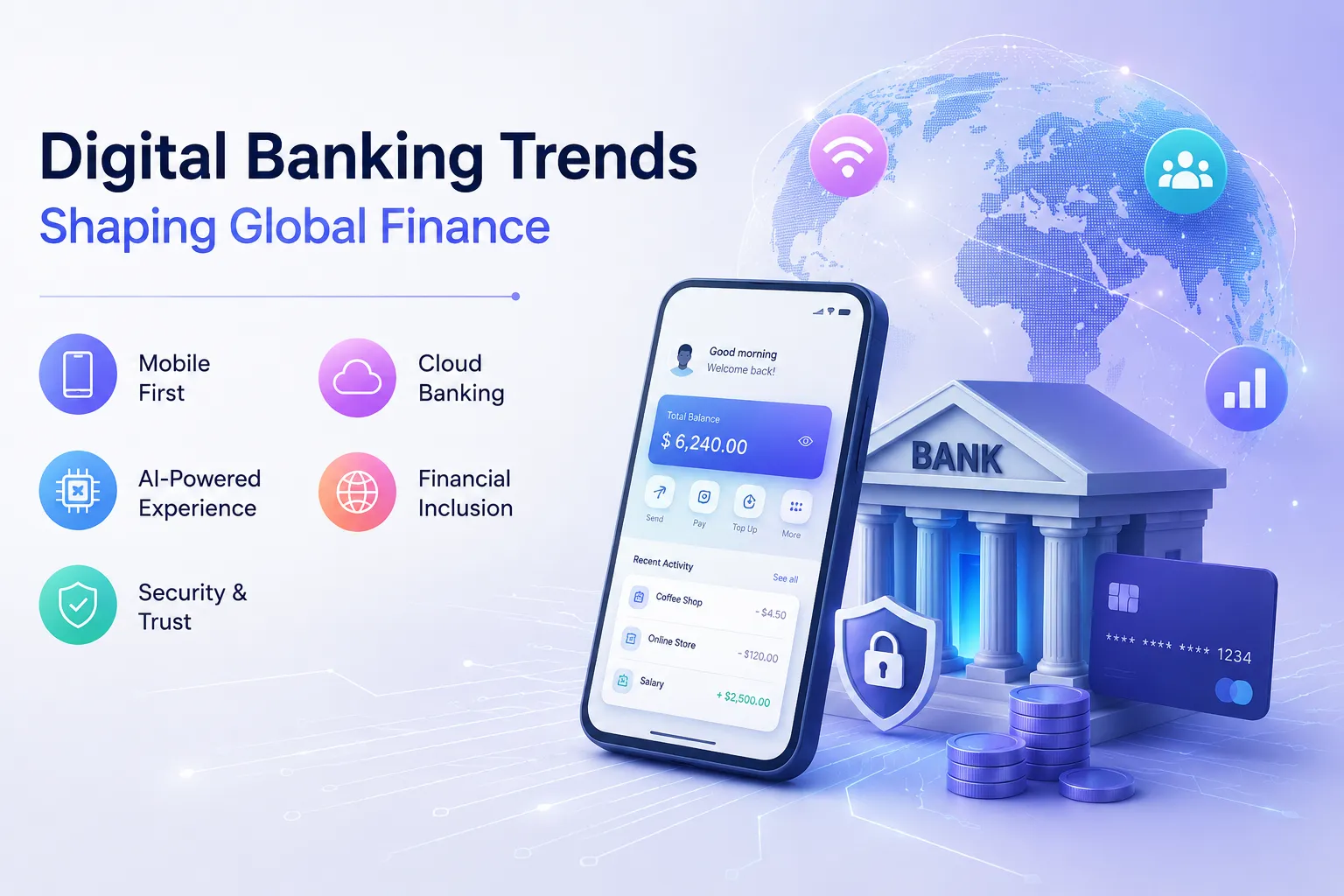
Digital Banking Trends Shaping Global Finance
The financial services industry is experiencing one of the most significant transformations in its history. Driven by rapid advancements in technology, changing consumer expectations, increasing regulatory support, and the rise of fintech innovation, digital banking has become a dominant force shaping the future of global finance.
Traditional banking institutions are no longer competing only with other banks. They now face competition from fintech startups, digital-only banks, payment technology companies, embedded finance providers, and global technology firms entering the financial ecosystem. Consumers increasingly expect instant access, personalized experiences, advanced security, and seamless digital interactions across all financial products and services.
From artificial intelligence and cloud computing to blockchain technology and open banking frameworks, the modern banking landscape is evolving at an unprecedented pace. Financial institutions that successfully embrace digital transformation are improving operational efficiency, reducing costs, enhancing customer satisfaction, and creating new revenue opportunities.
This comprehensive guide explores the most important digital banking trends shaping global finance, examines their impact on consumers and businesses, and highlights the opportunities and challenges facing the future of banking.
The Evolution of Digital Banking
Digital banking has evolved significantly over the past two decades. What began as simple online account access has transformed into fully digital financial ecosystems capable of delivering comprehensive banking services through mobile applications and cloud-based platforms.
Modern digital banking solutions now provide:
- Mobile account management
- Real-time payments
- Digital lending services
- Investment management tools
- Personal finance analytics
- Automated wealth management
- Cross-border payment solutions
| Banking Era | Primary Characteristics |
|---|---|
| Traditional Banking | Branch-Centric Services |
| Online Banking | Web-Based Account Access |
| Mobile Banking | Smartphone Financial Services |
| Digital Banking | Fully Integrated Digital Ecosystems |
Artificial Intelligence in Banking
Artificial intelligence has become one of the most influential technologies driving digital banking innovation.
Financial institutions use AI to automate operations, enhance customer experiences, improve fraud detection, and optimize decision-making processes.
AI-Powered Customer Service
Virtual assistants and intelligent chatbots now handle routine customer inquiries, reducing operational costs while improving service availability.
Predictive Financial Insights
AI systems analyze spending patterns and financial behavior to provide personalized recommendations.
Fraud Prevention
Machine learning algorithms continuously monitor transactions and identify suspicious activities in real time.
| AI Application | Primary Benefit |
|---|---|
| Chatbots | 24/7 Customer Support |
| Fraud Detection | Enhanced Security |
| Credit Analysis | Improved Lending Decisions |
| Personalization | Better Customer Experience |
Open Banking Revolution
Open banking is transforming how financial data is shared and utilized.
Under open banking frameworks, consumers can securely authorize third-party providers to access financial data through application programming interfaces (APIs).
Benefits include:
- Improved competition
- Enhanced innovation
- Personalized financial products
- Greater consumer control
- Integrated financial services
Open banking is creating a more connected and competitive financial ecosystem worldwide.
Rise of Neobanks and Challenger Banks
Neobanks are digital-only financial institutions operating without traditional branch networks.
These institutions offer:
- Lower operating costs
- Modern mobile experiences
- Competitive fee structures
- Faster account opening processes
- Innovative financial tools
Challenger banks continue gaining market share by targeting digitally focused consumers who prioritize convenience and technology-driven banking experiences.
Embedded Finance and Banking as a Service
Embedded finance allows financial products to be integrated directly into non-financial platforms.
Examples include:
- Buy Now Pay Later solutions
- Integrated payment processing
- Embedded lending products
- Insurance integration
- Business financing platforms
This trend is creating new opportunities for both financial institutions and technology companies.
Digital Payments Continue Expanding
Cashless transactions continue growing globally.
Consumers increasingly rely on:
- Digital wallets
- Contactless payments
- QR code payments
- Peer-to-peer transfers
- Instant payment networks
Businesses benefit from faster settlement times, improved efficiency, and enhanced customer experiences.
| Payment Method | Growth Potential |
|---|---|
| Digital Wallets | Very High |
| Contactless Cards | High |
| Instant Payments | Very High |
| Peer-to-Peer Transfers | High |
Cloud Computing and Banking Infrastructure
Cloud technology has become a critical component of digital banking transformation.
Financial institutions leverage cloud infrastructure to:
- Reduce technology costs
- Improve scalability
- Accelerate innovation
- Enhance disaster recovery capabilities
- Support global operations
Cloud adoption enables banks to respond more quickly to changing customer expectations and market conditions.
Cybersecurity as a Strategic Priority
As banking becomes increasingly digital, cybersecurity remains a top priority.
Financial institutions face threats including:
- Data breaches
- Ransomware attacks
- Identity theft
- Account takeover fraud
- Phishing attacks
To address these risks, banks invest heavily in advanced security technologies.
Multi-Factor Authentication
MFA significantly reduces unauthorized account access risks.
Behavioral Analytics
AI-driven systems monitor user behavior to detect anomalies.
Zero Trust Security Models
Modern security frameworks continuously verify users and devices before granting access.
Blockchain and Digital Assets
Blockchain technology continues influencing global finance.
Potential banking applications include:
- Cross-border payments
- Digital identity verification
- Trade finance automation
- Smart contracts
- Asset tokenization
Although adoption varies across regions, blockchain remains an important area of financial innovation.
Real-Time Payments and Instant Settlements
Consumers increasingly expect instant financial transactions.
Real-time payment systems enable:
- Immediate fund transfers
- Faster payroll processing
- Improved cash flow management
- Enhanced customer satisfaction
Many countries continue investing in faster payment infrastructure to support economic growth.
Personalized Banking Experiences
Digital banking platforms increasingly focus on personalization.
Using analytics and AI, banks can deliver:
- Customized financial advice
- Personalized product recommendations
- Targeted savings strategies
- Investment guidance
- Budgeting insights
Personalization improves customer engagement and loyalty.
Digital Lending Transformation
Lending processes are becoming increasingly automated.
Digital lending platforms use:
- Automated underwriting
- AI-based credit assessment
- Alternative data analysis
- Instant approval systems
This allows faster loan decisions while improving operational efficiency.
| Traditional Lending | Digital Lending |
|---|---|
| Manual Review | Automated Assessment |
| Days or Weeks | Minutes or Hours |
| Limited Data Sources | Expanded Data Analysis |
| Higher Costs | Lower Processing Costs |
Financial Inclusion Through Digital Banking
Digital banking is helping expand financial access globally.
Benefits include:
- Lower account costs
- Remote account opening
- Mobile financial services
- Access to credit products
- Small business financing opportunities
Technology-driven solutions are reducing barriers that historically limited financial participation.
Regulatory Technology (RegTech)
Financial institutions face increasing regulatory requirements.
RegTech solutions help automate:
- Compliance monitoring
- Risk reporting
- Know Your Customer processes
- Anti-money laundering controls
- Audit management
Automation improves efficiency while reducing compliance costs.
Digital Wealth Management
Wealth management services are increasingly digital.
Modern platforms offer:
- Automated portfolio management
- Investment analytics
- Retirement planning tools
- Tax optimization strategies
- Robo-advisory services
These innovations make sophisticated investment services accessible to broader audiences.
Sustainability and Green Finance Technology
Environmental, social, and governance (ESG) considerations are becoming increasingly important.
Digital banking platforms now support:
- ESG investing tools
- Carbon footprint tracking
- Sustainable lending programs
- Green finance products
Sustainability-focused financial solutions continue gaining popularity among consumers and investors.
Challenges Facing Digital Banking
Despite significant progress, digital banking faces ongoing challenges.
| Challenge | Potential Impact |
|---|---|
| Cybersecurity Threats | Operational Risk |
| Regulatory Complexity | Compliance Costs |
| Technology Integration | Implementation Delays |
| Consumer Trust | Adoption Barriers |
| Data Privacy | Legal and Reputational Risk |
The Future of Digital Banking
The future of banking will likely be defined by increased automation, artificial intelligence, embedded financial services, real-time payments, and hyper-personalized customer experiences.
Financial institutions that embrace innovation while maintaining strong security, compliance, and customer trust will be best positioned for long-term success.
Emerging technologies such as quantum computing, advanced AI systems, decentralized finance infrastructure, and next-generation payment networks may further reshape the industry over the coming decade.
Final Thoughts
Digital banking is no longer simply a convenience—it has become the foundation of modern financial services. From AI-powered customer experiences and open banking ecosystems to embedded finance, cloud infrastructure, and advanced cybersecurity solutions, technology continues to redefine how financial institutions operate and serve customers.
Consumers benefit from greater convenience, faster transactions, personalized financial tools, and broader access to financial services. Businesses gain operational efficiencies, enhanced payment capabilities, and new opportunities for growth. Meanwhile, financial institutions continue investing heavily in innovation to remain competitive in an increasingly digital world.
As digital transformation accelerates, the banking industry will continue evolving toward more connected, intelligent, secure, and customer-centric financial ecosystems. Understanding these trends is essential for consumers, investors, business leaders, and financial professionals seeking to navigate the future of global finance successfully.