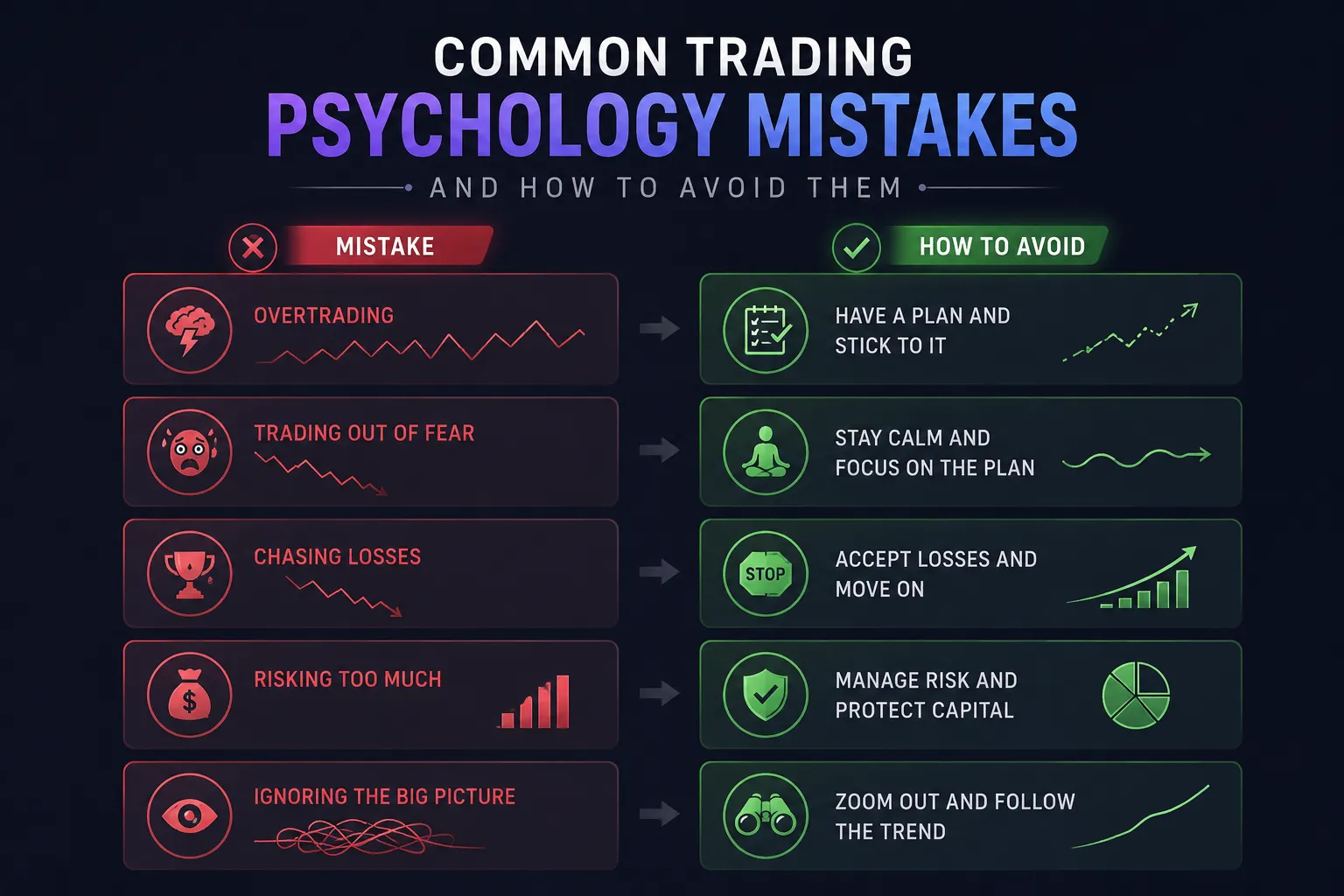
Common Trading Psychology Mistakes and How to Avoid Them
Successful trading is often portrayed as a combination of technical analysis, market knowledge, economic awareness, and risk management. While these factors are undeniably important, professional traders frequently agree on one critical truth: trading psychology often determines long-term success more than any chart pattern or indicator.
Many traders spend years mastering candlestick patterns, market cycles, options strategies, algorithmic trading systems, and portfolio management techniques. Yet despite having access to the same information, some traders consistently outperform while others struggle. The difference is often psychological.
Fear, greed, overconfidence, impatience, revenge trading, confirmation bias, and emotional decision-making can cause even experienced traders to abandon profitable strategies. Understanding these psychological pitfalls and developing systems to overcome them is essential for anyone participating in stocks, forex, futures, options, commodities, ETFs, or cryptocurrency markets.
This comprehensive guide explores the most common trading psychology mistakes, explains why they occur, and provides practical strategies to help traders improve discipline, consistency, and long-term profitability.
Why Trading Psychology Matters
Financial markets are driven by human behavior. While institutional algorithms and artificial intelligence increasingly influence trading activity, the underlying market dynamics still reflect collective emotions and decision-making.
Psychology affects:
- Trade entries
- Trade exits
- Risk management
- Position sizing
- Portfolio allocation
- Profit-taking decisions
- Loss management
Many traders fail not because their strategy lacks an edge, but because emotions prevent them from executing that strategy consistently.
| Trading Factor | Importance Level |
|---|---|
| Trading Strategy | High |
| Risk Management | Very High |
| Trading Psychology | Extremely High |
| Market Knowledge | High |
| Discipline | Critical |
Mistake #1: Trading Based on Fear
Fear is one of the most powerful emotions affecting traders. It often appears during periods of market volatility, economic uncertainty, or after experiencing losses.
Common Fear-Based Behaviors
- Closing winning trades too early
- Avoiding valid trading setups
- Reducing position sizes excessively
- Ignoring trading plans
- Panic selling during market declines
How to Avoid It
- Create a written trading plan
- Use predefined stop-loss levels
- Accept losses as part of trading
- Focus on probabilities rather than certainty
- Review historical strategy performance
Professional traders understand that no strategy wins every trade. Their confidence comes from long-term statistical advantages rather than individual outcomes.
Mistake #2: Greed and Overtrading
Greed often causes traders to take unnecessary risks in pursuit of larger profits.
Common symptoms include:
- Increasing position sizes aggressively
- Ignoring risk management rules
- Holding winning trades too long
- Taking excessive leverage
- Entering low-quality setups
Greed can quickly turn profitable trades into significant losses.
How to Avoid It
- Define profit targets before entering trades
- Maintain consistent position sizing
- Follow risk-reward guidelines
- Avoid increasing leverage after wins
- Focus on process instead of money
Mistake #3: Revenge Trading
Revenge trading occurs when traders attempt to recover losses quickly by taking impulsive trades.
This is one of the most destructive psychological mistakes because it often leads to:
- Larger losses
- Poor decision-making
- Increased emotional stress
- Capital destruction
| Healthy Response | Revenge Trading Response |
|---|---|
| Review the trade | Immediately enter another trade |
| Follow the trading plan | Abandon risk controls |
| Analyze mistakes | Focus on recovering losses |
| Stay objective | Trade emotionally |
How to Avoid It
- Take breaks after losses
- Set daily loss limits
- Review trades objectively
- Avoid emotional decision-making
- Focus on long-term performance
Mistake #4: Overconfidence After Success
A series of profitable trades can create dangerous overconfidence.
Traders may begin to believe they have mastered the market and start taking excessive risks.
Warning Signs
- Ignoring stop losses
- Increasing leverage dramatically
- Taking larger positions
- Breaking trading rules
- Assuming every trade will succeed
How to Avoid It
- Treat every trade independently
- Maintain consistent risk management
- Keep a trading journal
- Review losing periods regularly
- Stay humble and data-driven
Mistake #5: Confirmation Bias
Confirmation bias occurs when traders seek information that supports their existing opinions while ignoring contradictory evidence.
Examples include:
- Only reading bullish analysis when long
- Ignoring bearish signals
- Dismissing negative news
- Overlooking risk factors
How to Avoid It
- Actively search for opposing viewpoints
- Analyze both bullish and bearish scenarios
- Use objective checklists
- Follow predefined trading criteria
Mistake #6: Fear of Missing Out (FOMO)
FOMO is especially common in fast-moving markets such as technology stocks, options trading, cryptocurrencies, and momentum-driven assets.
Traders often chase rapidly rising prices because they fear missing profitable opportunities.
Consequences
- Poor entry points
- Increased risk exposure
- Buying near market tops
- Reduced risk-reward ratios
How to Avoid It
- Wait for planned setups
- Accept missed opportunities
- Remember markets provide endless opportunities
- Focus on quality rather than quantity
Mistake #7: Lack of Patience
Many traders struggle with waiting.
Impatience can lead to:
- Entering trades too early
- Exiting trades prematurely
- Forcing trades in poor conditions
- Ignoring strategy requirements
Professional trading often involves waiting for high-probability opportunities.
Mistake #8: Moving Stop Losses
One of the most common mistakes occurs when traders move stop-loss orders further away after entering a trade.
This behavior is often driven by hope rather than analysis.
Risks
- Larger losses
- Risk management failure
- Portfolio damage
- Emotional stress
Best Practice
Determine stop-loss levels before entering a trade and follow the plan consistently.
Mistake #9: Loss Aversion
Behavioral finance research shows that people generally experience the pain of losses more intensely than the pleasure of gains.
This often leads traders to:
- Hold losing positions too long
- Close winning positions too quickly
- Avoid necessary exits
| Healthy Behavior | Loss Aversion Behavior |
|---|---|
| Cut losses quickly | Hold losers indefinitely |
| Let winners run | Take profits too early |
| Follow strategy rules | Act emotionally |
Mistake #10: Trading Without a Plan
A surprising number of traders enter markets without clearly defined strategies.
A professional trading plan should include:
- Entry criteria
- Exit criteria
- Risk limits
- Position sizing rules
- Trading schedule
- Performance metrics
Without a plan, emotions often dominate decision-making.
The Role of Discipline in Trading Success
Discipline allows traders to execute strategies consistently regardless of emotional conditions.
Key elements include:
- Following rules
- Respecting stop losses
- Managing risk consistently
- Avoiding impulsive decisions
- Maintaining trading routines
Many successful traders describe discipline as their most valuable skill.
Building a Professional Trading Mindset
Professional traders approach markets differently than most beginners.
| Amateur Trader | Professional Trader |
|---|---|
| Focuses on profits | Focuses on process |
| Seeks certainty | Accepts uncertainty |
| Trades emotionally | Trades systematically |
| Overreacts to losses | Manages risk objectively |
| Chases opportunities | Waits for setups |
The Importance of a Trading Journal
A trading journal is one of the most effective tools for improving psychology and performance.
Traders should record:
- Entry reasons
- Exit reasons
- Position size
- Risk-reward ratio
- Emotional state
- Lessons learned
Over time, journals reveal recurring psychological patterns that may otherwise go unnoticed.
Risk Management and Emotional Control
Strong risk management reduces emotional stress.
When traders know losses are controlled, they can make decisions more objectively.
| Risk Management Tool | Psychological Benefit |
|---|---|
| Stop Loss Orders | Reduces fear |
| Position Sizing | Limits stress |
| Diversification | Reduces concentration risk |
| Daily Loss Limits | Prevents emotional spirals |
| Trading Plan | Provides structure |
How Modern Technology Influences Trading Psychology
Today's traders face unique psychological challenges due to:
- 24/7 market access
- Real-time notifications
- Social media influence
- Algorithmic trading activity
- Constant financial news coverage
Information overload can increase emotional decision-making and reduce discipline.
Many professional traders intentionally limit distractions and focus on structured analysis.
Creating a Psychological Trading Routine
Successful traders often follow routines that promote consistency.
- Pre-market preparation
- Trade planning
- Risk assessment
- Performance review
- Post-trade analysis
Routines help reduce impulsive behavior and strengthen discipline over time.
Final Thoughts
Trading psychology is one of the most overlooked yet critical aspects of market success. Fear, greed, revenge trading, overconfidence, confirmation bias, FOMO, impatience, and loss aversion can significantly undermine even the most effective trading strategies.
Successful traders recognize that emotional control is not about eliminating emotions entirely—it is about developing systems, routines, and risk management processes that prevent emotions from dictating decisions.
By maintaining discipline, following a structured trading plan, keeping a detailed trading journal, and focusing on long-term consistency rather than short-term outcomes, traders can avoid many of the psychological mistakes that derail performance and build a more sustainable path toward long-term profitability.