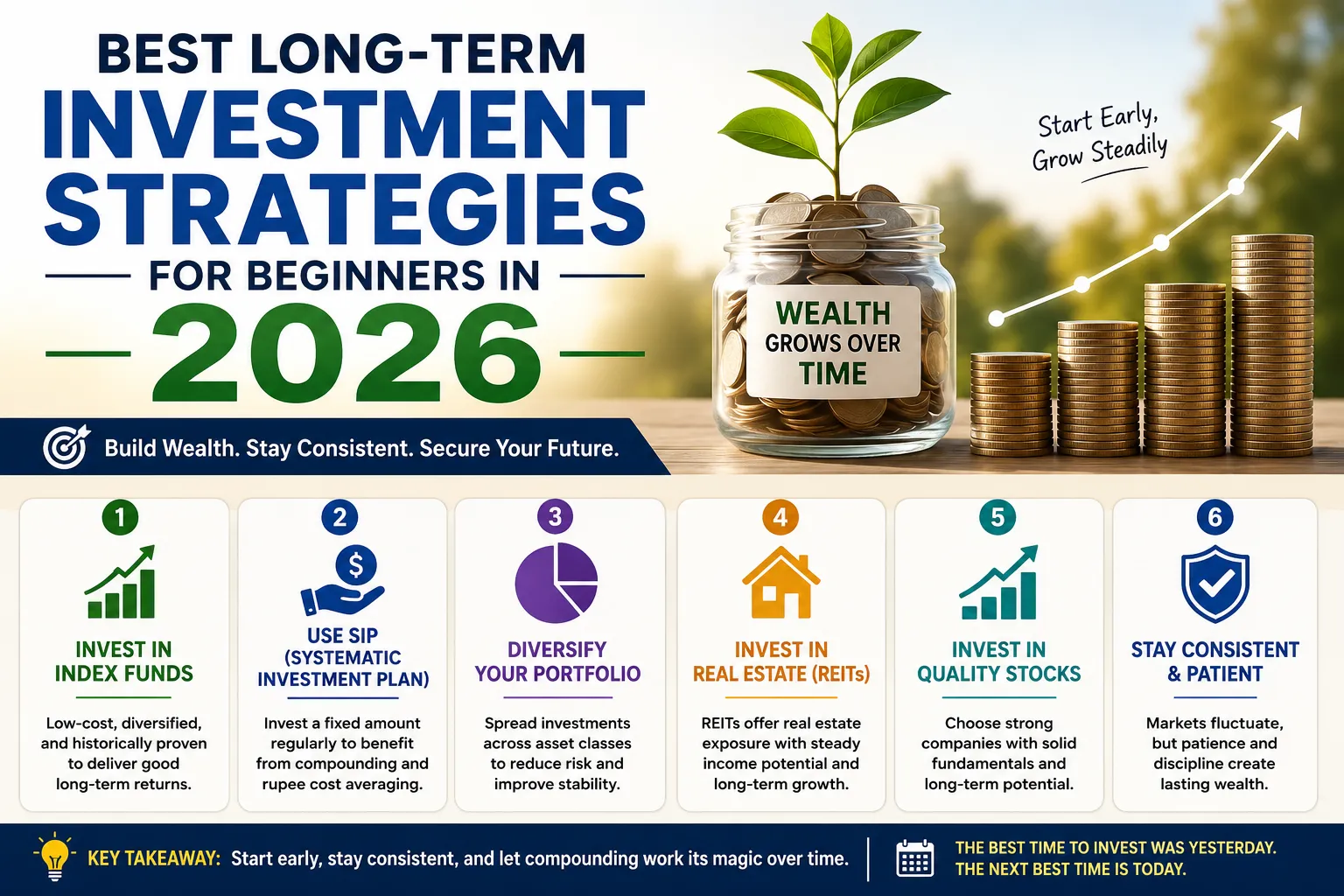
Best Long-Term Investment Strategies for Beginners in 2026
Building wealth is no longer reserved for financial experts or high-income earners. In 2026, beginners have access to more investment opportunities, digital platforms, and educational resources than ever before. Whether your goal is early retirement, financial independence, passive income generation, or simply growing your savings beyond inflation, understanding long-term investment strategies is one of the most valuable financial skills you can develop.
Many new investors focus on short-term market movements, trending stocks, or speculative assets. However, history consistently demonstrates that long-term investing remains one of the most reliable paths to wealth creation. Investors who stay disciplined, diversify their portfolios, and allow compound growth to work over decades typically outperform those who frequently buy and sell based on market emotions.
This comprehensive guide explores the best long-term investment strategies for beginners in 2026, including index funds, ETFs, dividend investing, retirement planning, real estate exposure, portfolio diversification, risk management, and wealth-building techniques designed to maximize long-term returns.
Why Long-Term Investing Works
Long-term investing focuses on holding quality assets for years or even decades. Instead of attempting to predict short-term price movements, investors benefit from economic growth, business expansion, dividend reinvestment, and compounding returns.
One of the most powerful concepts in investing is compound growth. Compounding allows investors to earn returns not only on their original investment but also on previously accumulated gains. Over time, this creates exponential wealth growth.
For example, an investor contributing consistently to a diversified investment portfolio can potentially build significant wealth over a 20- to 30-year period, even with modest monthly contributions.
The Investment Landscape in 2026
The financial markets in 2026 present unique opportunities for beginner investors. Several trends are shaping investment strategies:
- Growth of AI-driven businesses and technology sectors.
- Expansion of clean energy and sustainability investments.
- Increasing popularity of low-cost ETFs and index funds.
- Greater access to global investment markets.
- Improved digital investment platforms and robo-advisors.
- Rising importance of retirement planning due to longer life expectancy.
- Growing interest in passive income investments.
While new opportunities emerge, the fundamental principles of successful long-term investing remain unchanged: diversification, patience, consistency, and disciplined decision-making.
Strategy #1: Invest in Broad Market Index Funds
Index funds continue to be among the most recommended investments for beginners. These funds track major stock market indexes and provide instant diversification across hundreds or thousands of companies.
Benefits of Index Funds
- Low management fees.
- Broad diversification.
- Historically strong long-term returns.
- Reduced company-specific risk.
- Simple investment approach.
Instead of researching individual companies, investors gain exposure to entire markets. This significantly reduces risk while maintaining growth potential.
| Advantage | Benefit to Beginners |
|---|---|
| Diversification | Reduces investment risk |
| Low Costs | Higher net returns over time |
| Passive Management | Minimal maintenance required |
| Market Exposure | Participates in economic growth |
Strategy #2: Build Wealth Through ETFs
Exchange-Traded Funds (ETFs) offer flexibility, diversification, and cost efficiency. ETFs have become a preferred investment vehicle for many long-term investors because they combine the diversification benefits of mutual funds with the trading convenience of stocks.
Popular ETF categories include:
- Total market ETFs.
- Technology ETFs.
- Dividend ETFs.
- International market ETFs.
- Healthcare ETFs.
- Clean energy ETFs.
- Artificial intelligence ETFs.
For beginners, broad-market ETFs often provide an ideal balance between simplicity and growth potential.
Strategy #3: Focus on Consistent Contributions
One of the most effective investment habits is making regular contributions regardless of market conditions. This strategy, known as dollar-cost averaging, reduces the impact of market volatility.
Instead of trying to time the market, investors commit to investing a fixed amount regularly. This disciplined approach removes emotion from investment decisions and encourages long-term wealth accumulation.
Advantages of Dollar-Cost Averaging
- Reduces timing risk.
- Creates consistent investing habits.
- Lowers emotional decision-making.
- Builds wealth steadily over time.
- Suitable for all market conditions.
Strategy #4: Invest in Dividend Growth Stocks
Dividend investing remains one of the most attractive long-term strategies in 2026. Dividend-paying companies distribute a portion of profits to shareholders, creating a passive income stream while still offering capital appreciation.
Dividend growth companies often demonstrate:
- Strong financial stability.
- Reliable cash flow.
- Consistent profitability.
- Shareholder-friendly management.
- Lower volatility compared to speculative growth stocks.
Reinvesting dividends can significantly accelerate portfolio growth over time.
Strategy #5: Diversify Across Asset Classes
Diversification remains one of the most important risk-management tools available to investors. Rather than concentrating investments in one sector or asset type, diversification spreads risk across multiple categories.
| Asset Class | Purpose |
|---|---|
| Stocks | Growth |
| Bonds | Stability |
| Real Estate | Income and appreciation |
| International Assets | Global diversification |
| Cash Reserves | Liquidity |
A diversified portfolio helps reduce overall risk while maintaining growth opportunities.
Strategy #6: Consider Real Estate Exposure
Real estate continues to be a valuable long-term investment asset. While direct property ownership requires significant capital, beginners can gain exposure through real estate investment trusts (REITs).
Benefits include:
- Potential rental income.
- Property appreciation.
- Portfolio diversification.
- Inflation protection.
- Passive investment opportunities.
REITs allow investors to access commercial, residential, industrial, healthcare, and data-center properties without purchasing physical real estate.
Strategy #7: Invest for Retirement Early
Starting retirement investing early remains one of the most effective wealth-building decisions. Time is the greatest advantage a beginner investor possesses.
Early retirement investing benefits include:
- Maximum compound growth.
- Greater financial flexibility.
- Reduced pressure to save later.
- Potential tax advantages.
- Higher retirement income.
Even small monthly investments can grow substantially over multiple decades.
Strategy #8: Maintain a Long-Term Mindset
Market corrections and economic uncertainty are normal parts of investing. Successful investors understand that volatility is temporary while long-term growth is driven by innovation, productivity, and economic expansion.
Common mistakes beginners should avoid include:
- Panic selling during downturns.
- Chasing market trends.
- Overtrading.
- Ignoring diversification.
- Investing without clear goals.
- Attempting to predict short-term market movements.
Strategy #9: Leverage Technology and AI Investment Tools
Investment technology continues evolving rapidly in 2026. Robo-advisors, AI-powered portfolio management systems, automated investing platforms, and advanced financial planning tools help beginners make informed decisions.
Benefits include:
- Automated portfolio rebalancing.
- Low investment minimums.
- Goal-based investing.
- Tax optimization.
- Professional portfolio allocation.
These tools make investing more accessible than ever before.
Strategy #10: Invest in Global Markets
Global diversification allows investors to participate in growth opportunities beyond their home country. International exposure can reduce concentration risk while providing access to emerging industries and developing economies.
Potential benefits include:
- Broader diversification.
- Access to international growth markets.
- Reduced country-specific risk.
- Enhanced portfolio resilience.
How to Create a Beginner Investment Portfolio in 2026
A simple portfolio structure often outperforms complex investment strategies.
| Investment Type | Suggested Allocation |
|---|---|
| Broad Market ETFs | 50% |
| International ETFs | 20% |
| Dividend Investments | 15% |
| REITs | 10% |
| Cash Reserve | 5% |
Portfolio allocations should always reflect individual risk tolerance, financial goals, and investment timelines.
Risk Management Principles for Beginners
Managing risk is equally important as generating returns. Effective risk management strategies include:
- Maintaining diversification.
- Holding emergency savings.
- Investing only money designated for long-term goals.
- Reviewing portfolios periodically.
- Avoiding excessive leverage.
- Maintaining realistic expectations.
Risk cannot be eliminated entirely, but it can be managed intelligently.
The Power of Compound Growth
Compounding remains the foundation of long-term wealth creation. Investors who begin early and remain consistent often achieve better outcomes than those who attempt aggressive strategies later in life.
The combination of regular contributions, reinvested earnings, and long investment horizons creates exponential growth opportunities.
Financial Freedom Through Long-Term Investing
Long-term investing is not simply about accumulating money. It is about creating financial flexibility, reducing dependence on employment income, building passive cash flow, and achieving life goals.
Whether the objective is retirement, education funding, home ownership, business creation, or generational wealth transfer, investing provides a structured pathway toward financial independence.
Future Investment Trends to Watch Beyond 2026
Several sectors may continue attracting investor attention over the coming decade:
- Artificial Intelligence.
- Cloud Computing.
- Cybersecurity.
- Digital Infrastructure.
- Healthcare Innovation.
- Renewable Energy.
- Automation Technologies.
- Data Centers.
- Financial Technology.
- Semiconductor Manufacturing.
While these sectors offer growth potential, diversification should remain the foundation of any investment strategy.
Final Thoughts
The best long-term investment strategy for beginners in 2026 is not about finding the next hot stock or predicting market movements. Instead, success comes from following proven principles: investing consistently, maintaining diversification, controlling costs, reinvesting earnings, and staying focused on long-term objectives.
Index funds, ETFs, dividend growth investments, retirement accounts, and real estate exposure continue to offer some of the strongest opportunities for wealth creation. By starting early and remaining disciplined, investors can harness the power of compound growth and significantly improve their financial future.
The journey toward financial freedom begins with a single investment decision. The sooner that journey starts, the more time your money has to work for you. In an increasingly complex financial world, simple, diversified, and long-term strategies remain the most effective approach for beginner investors seeking sustainable wealth creation in 2026 and beyond.