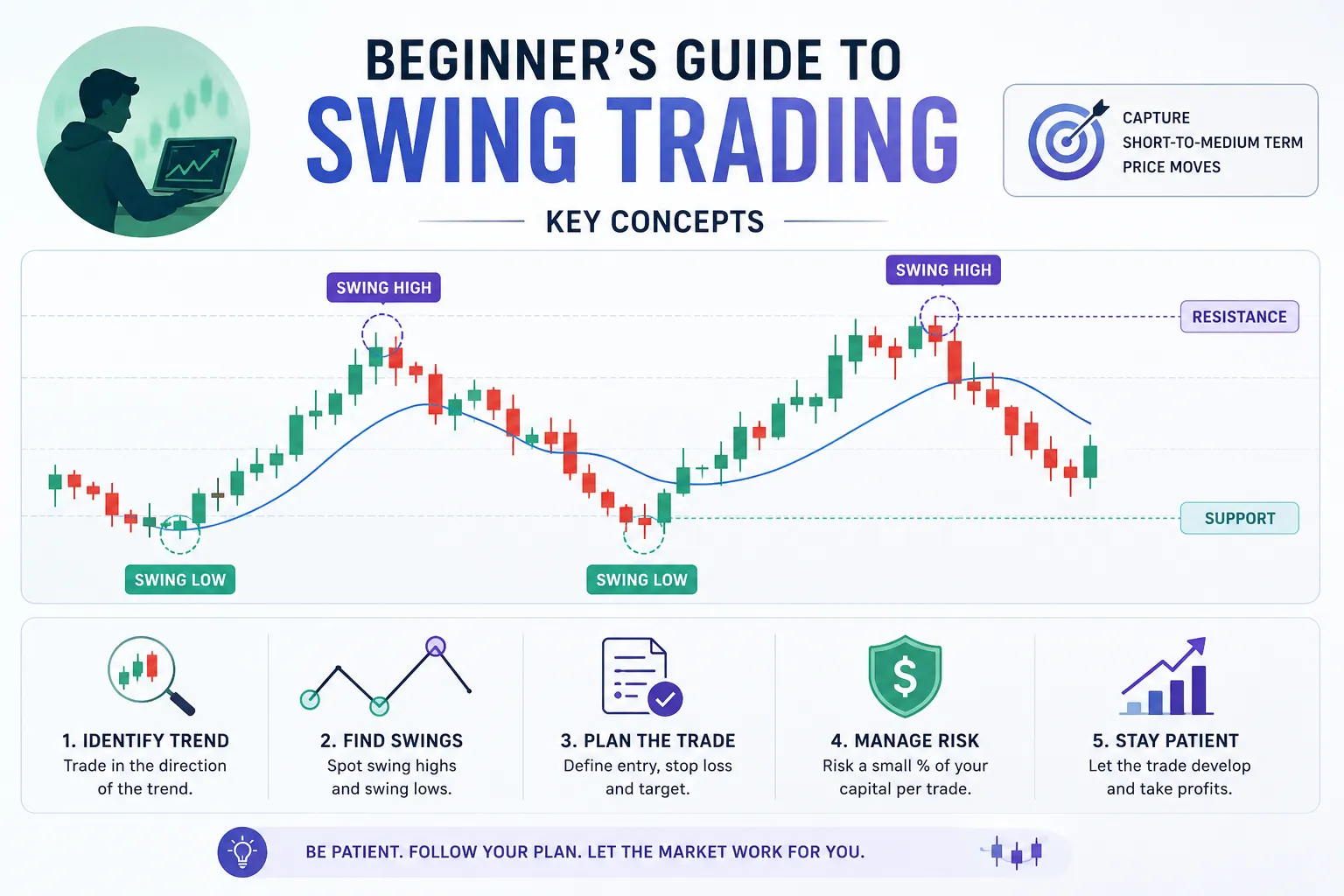
Beginner's Guide to Swing Trading Concepts
Swing trading is one of the most popular trading styles among individual investors because it offers a balance between long-term investing and fast-paced day trading. Unlike day traders who may open and close positions within minutes or hours, swing traders aim to capture price movements that occur over several days or weeks. This approach allows traders to participate in market opportunities without spending every minute watching charts.
In today's financial markets, swing trading has become increasingly accessible thanks to advanced trading platforms, mobile investing apps, real-time market data, artificial intelligence-powered analysis tools, and commission-free brokerage accounts. Whether trading stocks, exchange-traded funds (ETFs), forex pairs, options, commodities, or cryptocurrencies, swing trading offers opportunities to profit from short-to-medium-term price trends.
However, successful swing trading requires more than simply buying low and selling high. Traders must understand market structure, technical analysis, risk management, trading psychology, trend identification, and portfolio management. This guide provides a comprehensive introduction to swing trading concepts designed specifically for beginners looking to build a solid foundation.
What Is Swing Trading?
Swing trading is a trading methodology focused on capturing market 'swings' or price movements that occur over several days, weeks, or occasionally months. Swing traders seek to profit from intermediate trends rather than long-term investments or very short-term price fluctuations.
The primary goal is to identify opportunities where an asset is likely to move significantly in one direction and then exit before the trend reverses.
| Trading Style | Typical Holding Period | Time Commitment |
|---|---|---|
| Scalping | Seconds to Minutes | Very High |
| Day Trading | Minutes to Hours | High |
| Swing Trading | Days to Weeks | Moderate |
| Position Trading | Weeks to Months | Low |
| Long-Term Investing | Years | Very Low |
Why Swing Trading Is Popular
Swing trading appeals to many traders because it combines flexibility with opportunity.
- Less screen time than day trading
- More opportunities than long-term investing
- Works across multiple markets
- Can be performed alongside a full-time job
- Allows for structured risk management
- Suitable for beginners and experienced traders
Many successful traders view swing trading as a practical approach to participating in financial markets while maintaining a balanced lifestyle.
How Swing Trading Works
Swing traders attempt to identify price movements before they occur and position themselves accordingly.
A typical swing trade involves:
- Identifying a potential trading opportunity.
- Analyzing trend direction.
- Determining entry and exit levels.
- Managing risk with stop-loss orders.
- Holding the position until the target is reached.
Rather than predicting every market move, swing traders focus on capturing a portion of a larger trend.
Understanding Market Trends
Trend analysis forms the foundation of swing trading.
Uptrend
An uptrend consists of higher highs and higher lows, indicating strong buying pressure.
Downtrend
A downtrend consists of lower highs and lower lows, indicating dominant selling pressure.
Sideways Trend
A range-bound market moves between support and resistance without a clear direction.
| Trend Type | Characteristics |
|---|---|
| Uptrend | Higher Highs, Higher Lows |
| Downtrend | Lower Highs, Lower Lows |
| Sideways | Support and Resistance Range |
Support and Resistance Levels
Support and resistance are critical concepts for swing traders.
Support is an area where buying pressure tends to emerge.
Resistance is an area where selling pressure often appears.
These levels help traders:
- Identify entry opportunities
- Place stop losses
- Set profit targets
- Evaluate risk-reward ratios
Risk Management: The Most Important Skill
Many beginners focus exclusively on finding winning trades. Professional traders focus on managing losses.
Risk management determines long-term survival in financial markets.
Core Principles
- Never risk too much on one trade
- Always use stop-loss orders
- Maintain favorable risk-reward ratios
- Diversify when appropriate
- Protect trading capital
| Account Size | Maximum Risk Per Trade (1%) |
|---|---|
| $10,000 | $100 |
| $25,000 | $250 |
| $50,000 | $500 |
| $100,000 | $1,000 |
Importance of Risk-Reward Ratios
Risk-reward ratio compares potential profit to potential loss.
Example:
- Risk: $100
- Potential Reward: $300
- Risk-Reward Ratio: 1:3
Many professional traders seek opportunities with favorable ratios because they improve profitability even when win rates are modest.
Technical Analysis Basics
Technical analysis studies price movements and chart patterns to identify potential trading opportunities.
Swing traders commonly use:
- Price action analysis
- Trendlines
- Support and resistance
- Volume analysis
- Technical indicators
- Candlestick patterns
Popular Swing Trading Indicators
Moving Averages
Moving averages help identify trend direction.
- 20-Day Moving Average
- 50-Day Moving Average
- 100-Day Moving Average
- 200-Day Moving Average
Relative Strength Index (RSI)
RSI measures momentum and can identify overbought or oversold conditions.
MACD
The Moving Average Convergence Divergence indicator helps traders evaluate momentum shifts and trend strength.
Volume
Volume confirms market participation and often validates breakouts.
| Indicator | Primary Purpose |
|---|---|
| Moving Average | Trend Identification |
| RSI | Momentum Analysis |
| MACD | Trend Momentum |
| Volume | Trade Confirmation |
Chart Patterns Every Beginner Should Know
Double Bottom
A bullish reversal pattern indicating potential upward movement.
Double Top
A bearish reversal pattern suggesting potential downside risk.
Ascending Triangle
Often considered a bullish continuation pattern.
Descending Triangle
Commonly viewed as a bearish continuation pattern.
Flag Patterns
Short-term consolidations that often occur before trend continuation.
Candlestick Patterns for Swing Traders
Candlestick analysis provides valuable insight into market sentiment.
- Hammer
- Shooting Star
- Bullish Engulfing
- Bearish Engulfing
- Morning Star
- Evening Star
- Doji
These patterns become more effective when combined with support, resistance, and volume analysis.
Finding Swing Trading Opportunities
Successful swing traders typically follow a structured process.
- Screen for strong stocks or assets.
- Identify clear trends.
- Locate support and resistance levels.
- Analyze volume behavior.
- Evaluate risk-reward potential.
- Plan trade execution.
Sector and Industry Analysis
Strong sectors often produce the best swing trading opportunities.
Popular growth-focused sectors include:
- Technology
- Artificial Intelligence
- Cybersecurity
- Semiconductors
- Cloud Computing
- Healthcare Innovation
- Digital Payments
- Renewable Energy
Many traders focus on leading sectors because institutional capital frequently flows into these areas.
Swing Trading Stocks vs ETFs
| Asset Type | Advantages | Challenges |
|---|---|---|
| Stocks | Higher Growth Potential | Higher Volatility |
| ETFs | Diversification | Lower Individual Upside |
Beginners often find ETFs easier because they provide built-in diversification.
Trading Psychology for Beginners
Psychology is often more important than technical analysis.
Common mistakes include:
- Fear of missing out (FOMO)
- Revenge trading
- Overconfidence
- Moving stop losses
- Ignoring risk management
- Overtrading
Successful swing traders maintain discipline regardless of market conditions.
Creating a Swing Trading Plan
Every trader should develop a written trading plan.
The plan should include:
- Markets traded
- Entry criteria
- Exit criteria
- Risk limits
- Position sizing rules
- Trading schedule
A written plan reduces emotional decision-making and improves consistency.
Keeping a Trading Journal
A trading journal helps identify strengths and weaknesses.
Track:
- Trade entries
- Trade exits
- Profit and loss
- Emotional state
- Lessons learned
Over time, journals become powerful performance-improvement tools.
Common Beginner Mistakes
| Mistake | Potential Consequence |
|---|---|
| Overtrading | Excessive losses |
| No Stop Loss | Large drawdowns |
| Emotional Trading | Poor decisions |
| Ignoring Trends | Low-probability setups |
| Excessive Leverage | Capital destruction |
Technology and Modern Swing Trading
Today's traders benefit from powerful tools including:
- AI-powered stock screeners
- Advanced charting platforms
- Algorithmic alerts
- Real-time market scanners
- Mobile trading applications
- Cloud-based portfolio tracking
Technology has made market analysis more accessible than ever before.
Building Long-Term Trading Success
Successful swing trading requires:
- Patience
- Discipline
- Risk management
- Continuous education
- Performance review
- Emotional control
Most profitable traders focus on consistent execution rather than trying to predict every market move.
Final Thoughts
Swing trading offers a practical and flexible approach to participating in modern financial markets. By holding positions for several days or weeks, traders can capture meaningful price movements without the constant pressure associated with day trading.
Success in swing trading comes from understanding trends, support and resistance, technical analysis, risk management, and trading psychology. While no strategy guarantees profits, developing a structured trading plan and consistently applying proven principles can significantly improve long-term performance.
For beginners, the most important objective is not maximizing profits immediately but building skills, preserving capital, and developing the discipline necessary for sustainable success. As experience grows, traders can refine their strategies and confidently navigate opportunities across stocks, ETFs, forex, options, and cryptocurrency markets.